
Quick answer: Buy your Texas CR-3 through TxDOT's official crash report purchase system. TxDOT lists $6 for a regular copy and $8 for a certified copy; reports arrive by email.
The officer must file the report with TxDOT within 10 days of the crash, but processing can add time. People with a proper interest in the crash — those involved and other qualifying requesters — can get the full report; others receive a redacted version.
Direct links: TxDOT Crash Report Online Purchase System and TxDOT's crash reports and records page.

What Is a CR-3 Crash Report?
The CR-3 is the standardized form Texas peace officers use to document a motor vehicle crash they investigate. Under Transportation Code section 550.062, an officer who investigates a crash must make a written report when the crash results in injury, death, or apparent damage of $1,000 or more to any one person's property, and must file it electronically with the department no later than the 10th day after the crash.
The report records the parties, vehicles, and insurance information, the officer's diagram and narrative of how the crash happened, contributing factors the officer identified, citations issued, and injury codes. For a commercial truck crash it also captures carrier information, which is often the first documented link between the truck that hit you and the company identified as the motor carrier/operator. Statewide, these CR-3 filings are the raw material behind crash statistics, including our own county-by-county analysis of Texas truck crash data.
For a collision near Waco's I-35 South corridor, record the particular ramp or frontage-road location alongside the report details. For a crash around Denton's I-35E/I-35W junction, preserve the branch, direction and lane information you have. Those details help distinguish the incident and identify other records to investigate; the city name alone does not identify the investigating agency.
How Do You Buy the Report Online?
TxDOT centralizes crash reports statewide, so you do not need to visit the police department that worked your crash. The steps:
- 1. Wait for the report to be filed and processed. The officer must file the CR-3 with TxDOT within 10 days of the crash. That is a filing deadline, not a promise the report is ready to buy on day 10 — TxDOT still has to process it, so allow extra time. If a search comes up empty at first, try again in a few days.
- 2. Gather your details from the paperwork. Before you search, pull the crash date, the location and county, the investigating agency, any case or reference number, and the driver names off whatever the officer handed you at the scene. Keep the agency's own case number separate from the TxDOT crash ID — they are different numbers, and mixing them up is a common reason a search fails.
- 3. Go to the purchase system and follow the prompts. TxDOT's crash records page directs buyers to the Crash Report Online Purchase System. Enter the details you gathered and follow the on-screen prompts; the system will ask you to confirm your identity and that you qualify to receive the report.
- 4. Choose regular or certified. A regular copy is $6 and a certified copy is $8. The certified copy carries the department's certification, and TxDOT notes that a certified copy is the one typically requested for official or legal proceedings. If you need an official copy for a legal proceeding, confirm the receiving court or agency's requirements before choosing.
- 5. Pay, then check your email. TxDOT states that online customers receive their reports by email after purchase, so watch your inbox and your spam or junk folder. Note that credit card transactions can carry additional processing fees.
TxDOT's page also notes that since January 1, 2025 it no longer accepts subpoena and affidavit requests by mail; those now go through the online CRIS request system, with processing quoted at 10 to 20 business days.
What If the Report Is Not Found?
An empty search usually means one of a few fixable things, not that the report does not exist:
- Recheck what you typed. Confirm the crash date, the county, and the spelling of names against your paperwork, and make sure you used the TxDOT crash ID rather than the agency's own case number.
- It may be filed but not yet processed. Filing within 10 days is the officer's deadline; processing into the searchable system can take longer. Wait a few days and search again before assuming anything is wrong.
- Ask the investigating agency. Contact the police department, sheriff, or DPS office that worked the crash to confirm the report was actually filed and to ask which identifiers to use when you search.
- There may be no CR-3 at all. A CR-3 exists only when a peace officer investigated the crash. If no officer investigated, there is no CR-3 to buy. TxDOT no longer retains or hosts the older driver-filed CR-2 "blue form," so it will never appear in the online purchase system. Keep your own documentation of the collision — photos, names, insurance details — and do not submit a CR-2 to TxDOT.
- Missing or wrong information on a report that does exist. Requests to correct or supplement a filed report go to the investigating agency, not TxDOT.
One more thing worth knowing: TxDOT keeps crash reports for ten full years plus the current year. TxDOT is custodian of the crash report, not the scene photos, dashcam video, or field notes. Ask the investigating agency promptly about obtaining those separate materials and its retention requirements.
Who Can Get an Unredacted Copy?
Crash reports are not fully public, but the pool of people who qualify is broader than just the drivers in the crash. Under Transportation Code section 550.065, the full report is released to people directly concerned in the crash or holding a proper interest in it. TxDOT's crash records page lists the qualifying categories, which include the people involved in the crash, their authorized representatives, the owners of vehicles or property damaged, insurers of an involved person or vehicle, an employer, parent, or legal guardian of a driver involved in the crash, and other statutory categories such as government agencies and news media. That list is what controls, so check it against your own situation rather than assuming you are shut out. Requesters who do not fall into a qualifying category are not barred from the report; they receive a redacted copy with the personal identifying information stripped out.
What Does the Report Cost?
At the time we reviewed TxDOT's crash records page, the listed fees were $6 for a regular copy and $8 for a certified copy, which matches the statute's structure of a $6 copy fee plus $2 for certification under section 550.065(d). Fees are set by the state and the portal has the current figures, so treat the numbers there as controlling if they differ from this article.
How Is the CR-3 Used in a Truck Accident Claim?
The report is usually the first document every insurer reads, and it frames the early fight. An officer's narrative placing fault on the truck driver, a citation issued at the scene, and the contributing factors the officer coded each shape how the carrier's insurer values the claim. In our six-month, $1 million Tomball Parkway settlement, the investigating officer's determination that the commercial truck entered an occupied lane gave the case its liability backbone from day one. Past results are no guarantee of what another case will bring.
But the CR-3 has limits. The officer usually did not witness the crash, worked from statements and scene evidence, and completed the form under time pressure. It cannot tell you what the truck's engine module recorded or whether the driver was over his federal hours. Serious cases are built on the evidence underneath the report, which is why preserving the truck's data quickly matters more than any single document. Start with our guide on what to do when getting injured in a truck accident.
What If the Report Is Wrong?
It happens: transposed vehicles, a missed witness, a narrative that accepted the truck driver's version because the injured person was in an ambulance and never got to talk. If you believe your report contains an error, contact the investigating agency, since the officer who wrote the report is generally the one who can amend or supplement it. Agencies differ on what they will correct, and factual disputes about fault are less likely to be changed than clerical errors. For the full process — how to request a correction, what evidence to include, and what to do if the agency declines — see our guide on whether a police report can be changed after an accident in Texas.
The good news is that an unfavorable report does not end a claim. The report is the officer's opinion, and opinions can be rebutted with reconstruction analysis, electronic data, and witnesses the officer never interviewed. Sgt. Pike's Truck Accident Response Team deploys to the crash area to gather exactly that evidence, with five roles working the scene: an attorney, a crash reconstruction expert, a safety expert, an investigator, and a nurse practitioner.
Get the Report, Then Get Help Reading It
Sgt. Pike, a Green Beret with 30 years of trial experience and more than $750 million recovered for injured Texans, reviews crash reports for free and will tell you plainly what yours means for your claim. Whether your wreck involved an 18-wheeler on a Houston freeway or a delivery truck on a farm road, the review costs nothing and there is no fee unless he wins. Call (832) 250-4888 or send us the basics and we will pull the report apart line by line.
Read Your CR-3, Field by Field
A CR-3 is dense with numbers and codes. This is a plain-language reference to the fields that matter most in a truck case — what each one is, and, just as important, what it is not. It is a selected reference, not a complete decoder: pick a field before you read a bare code, because the same number means different things on different parts of the form. Every entry links to the exact code-sheet page of TxDOT's official manual, which verifies the code-and-label mapping — not the full written explanation. For the fuller narrative definitions, follow the section links below.
This reference covers the current Texas CR-3 (form revision 4/1/2023, used for crashes on or after April 1, 2023) and its instruction manual, CR-100 version 29 (v29), revised June 4, 2025. Older crash-report forms used different code sheets — do not read these meanings onto an earlier report. For historic forms and code sheets, see TxDOT’s crash-report forms for law enforcement.
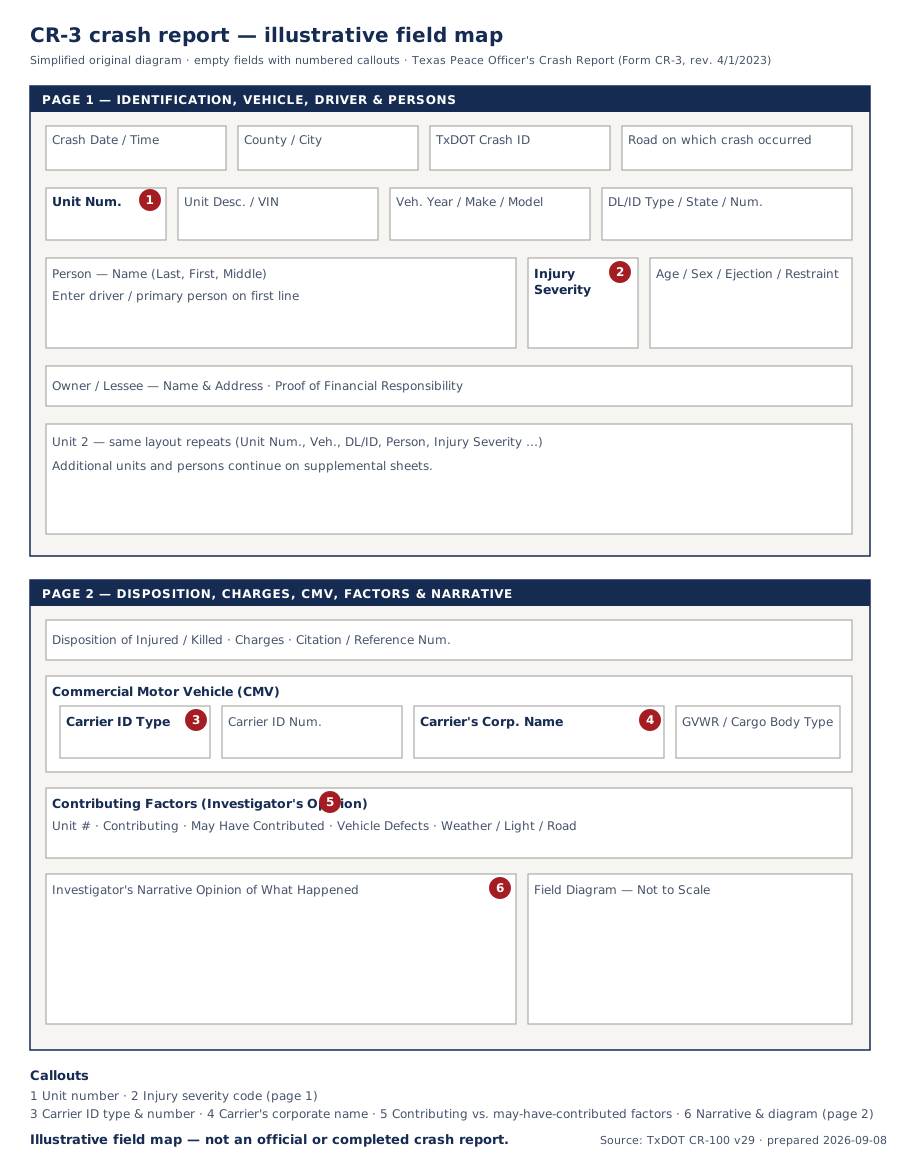
- Unit number page 1 — Each vehicle is a numbered unit. Everything for that vehicle — driver, injuries, factors — is tied to its unit number. Unit 1 is just the first unit listed; it is not automatically the at-fault unit.
- Injury severity code page 1 — The officer's field observation of the worst injury to each person (see the codes below). It is not a medical diagnosis or a prognosis.Jump to the codes.
- Carrier ID type & number page 2 — For a commercial vehicle, the type of regulator ID and the ID number itself. The type code labels which ID it is — not the number, and not who is legally responsible.Jump to the codes.
- Carrier's corporate name page 2 — The motor carrier responsible for operating the vehicle at the time of the crash. This may not be the registered owner shown on the registration — the operator and the registered owner can differ, and the name here does not by itself assign liability.
- Contributing vs. may-have-contributed factors page 2 — The investigator's opinion of what contributed, tied to a unit number. A separate "May Have Contributed" column records a factor that was present when the investigator could not tell whether it actually contributed.Jump to the codes.
- Narrative & field diagram page 2 — The officer's written account and a not-to-scale diagram. Like the factors, this is opinion built from statements and scene evidence, not a final legal finding.
This reference works without JavaScript — every field and code is listed in full below. With JavaScript on, the controls below filter the list.
24 shown
No results match that search. Check the spelling, choose a different field, or read the full, authoritative definitions in TxDOT’s official CR-3 instruction manual (CR-100 version 29 (v29)).
Source references checked September 8, 2026, against TxDOT’s CR-100 version 29 (v29). The per-code links verify the code-sheet mappings, not the full field explanations.
Injury Severity
The officer records the most serious injury for each person in the crash. It is the officer's field observation, not a medical diagnosis or a prognosis.
- A
- B
- C
- K
- N
- 95
- 99
Carrier ID Type
For a commercial vehicle, this codes which regulator issued the carrier's identification number. It labels the TYPE of ID — it is not the ID number itself, and it does not decide who is legally responsible.
- 1
- 2
- 3
- 96
- 98
Other (Explain in Narrative) p.108 #
Some other identifier applies; the officer explains it in the narrative. This verified table has no 99 – Unknown value. If a report shows a value that is not listed here, check the official manual or ask the investigating agency rather than assuming what it means.
Contributing Factor
Factors are the investigator's opinion of what contributed to the crash, tied to a specific unit number. A factor is not a finding of legal fault and does not set a settlement value. A separate "May Have Contributed" column records a factor that was present when the investigator could not determine whether it actually contributed.
The per-code links above point to the code sheet (p. 133), which confirms each code and label. For the fuller written definitions, see the manual’s factor definitions (pp. 136–142); for how factors are applied, see the application notes (pp. 134–135).
- 4
- 19
- 20
- 22
Failed to Control Speed p.133 #
The operator failed to control speed as necessary to avoid colliding with a person or vehicle lawfully on or entering the highway. This is distinct from speeding: it is NOT automatically factor 61 – Speeding (Over Limit), and the manual bars pairing 22, 60, and 61 on the same unit.
- 40
- 44
- 50
- 52
- 60
- 61
- 74
- 75
Worked examples anywhere in this guide are hypothetical and are not real crash records. For the complete, controlling definitions, always use TxDOT’s official CR-3 instruction manual and crash records page.
Frequently Asked Questions
How long does it take for a Texas crash report to be available?
The investigating officer must file the report electronically with TxDOT no later than the 10th day after the crash, under Transportation Code section 550.062. Processing can add time on top of that, so if your search comes up empty in the first week or two, check the portal again rather than assuming the report does not exist.
How much does a Texas CR-3 crash report cost?
At the time TxDOT's crash records page was last reviewed, a regular copy cost $6 and a certified copy cost $8, with possible extra processing fees for credit card transactions. Fees are set by the state and can change, so confirm the current amount on the TxDOT purchase portal before ordering.
Who is allowed to get a copy of a Texas crash report?
Texas releases crash reports to people directly concerned in the crash or with a proper interest in it, including the drivers involved, their representatives, vehicle owners, and the insurers covering the people or vehicles involved. Requesters who do not qualify receive a redacted copy with identifying information removed.
What if the police report about my truck accident is wrong?
The report reflects the investigating officer's findings, and officers can get things wrong. You can contact the investigating agency to ask about correcting or supplementing the report, though agencies differ in what they will change. In a legal claim, the report is not the last word. Physical evidence, the truck's electronic data, and witness testimony can all rebut it.
Is the CR-3 crash report enough to win my truck accident claim?
No. It is the starting document, not the whole case. Insurers dispute unfavorable reports, and the report itself cannot capture the truck's speed data, the driver's hours, or the carrier's safety history. Winning a contested truck case takes the evidence behind the report, gathered before it disappears.

No fee unless we win.
Past results do not guarantee a similar outcome.