
Updated October 2026. Every figure links to the agency, court or researcher that produced it.
No state puts more large trucks into fatal crashes than Texas. In 2024, 699 large trucks were involved in fatal crashes here, the highest count in the country (NHTSA, Jun 2026). Crashes involving commercial vehicles caused 14% of all Texas road deaths in 2025, 528 of 3,769 (TxDOT, Apr 2026).
This page is written for the people on the other side of those numbers: drivers, passengers and families hit by an 18-wheeler. Every stat comes from the source that produced it, such as NHTSA, TxDOT, FMCSA, CVSA, federal and Texas law, and Texas courts. We don't cite other law firms' statistics pages. Where the data cuts against crash victims, we report it anyway and explain what it means for a claim.
Looking for your county's numbers? See our Texas truck crash rankings by county. For deadly corridors, see the most dangerous highways in Texas.
- 720 people died in Texas large-truck crashes in 2024, more than in any other state (NHTSA, Jun 2026).
- 511 of those 720 Texans were in other vehicles, not the truck (NHTSA, Jun 2026).
- Commercial vehicle crash deaths in Texas fell to 528 in 2025, down from 608 in 2024 (TxDOT, Apr 2026).
- 22.3% of fatal Texas truck crashes happened between midnight and 6 a.m. (NHTSA FARS, Mar 2026).
- 43.6% of fatal Texas truck crashes happened in the dark, and 29.2% on roads with no lighting (NHTSA FARS, Mar 2026).
- Inspectors pulled 19% of trucks and 5.8% of drivers off the road during the 2026 Roadcheck blitz (CVSA, Aug 2026).
- 19.3% of large-truck drivers in fatal crashes already had a recorded crash in the prior five years (NHTSA, Jun 2026).
- Truck drivers were coded as feeling work pressure in 9.9% of truck and car crashes, nearly four times the rate for car drivers (2.6%) (FMCSA, Mar 2006).
- One fatal large-truck crash costs $15,230,414, in 2023 dollars (FMCSA, Feb 2026).
- The $750,000 federal insurance minimum for general freight carriers has been in force since January 1, 1985 (Code of Federal Regulations, Oct 2024).
- Only 298 of 55,275 motor vehicle injury cases closed in Texas district courts in FY2025 ended in a jury verdict (Texas Office of Court Administration, Dec 2025).
- The Supreme Court of Texas threw out a Houston jury's truck crash verdict in Werner v. Blake in June 2025, over a three-justice partial dissent (Supreme Court of Texas, Jun 2025).
How does Texas compare with other states for truck crash deaths?
Texas isn't just big. Trucks make up a bigger share of its fatal crashes than the national average, and the state leads the country on almost every truck fatality count.
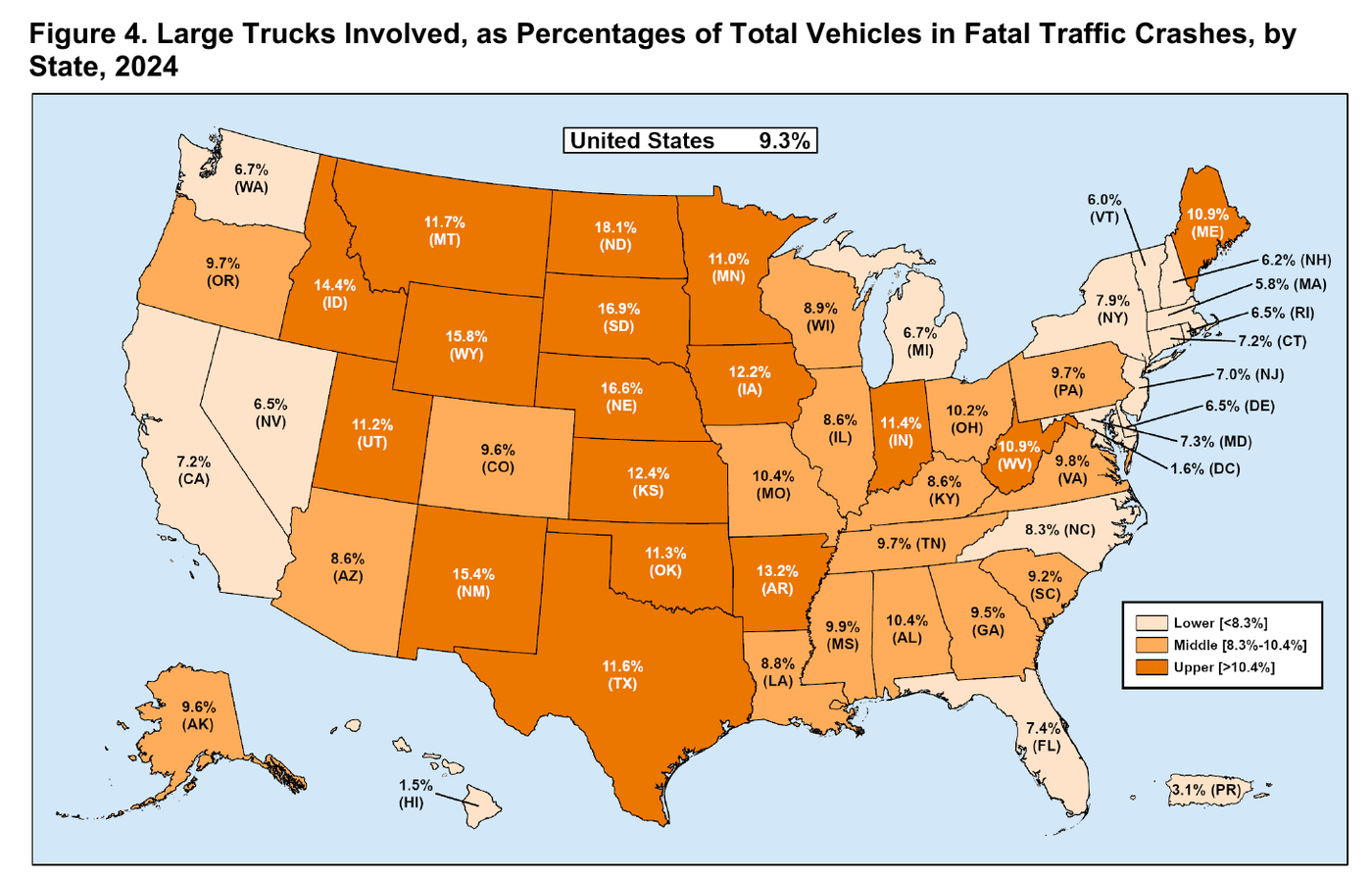
Does Texas lead the nation in truck crash deaths?
Yes. Texas leads on total deaths, trucks involved and the share of the national toll.
- Texas accounted for 13.4% of all large trucks involved in U.S. fatal crashes in 2024 (NHTSA, Jun 2026).
- Large trucks were 11.6% of all vehicles in Texas fatal crashes, against 9.3% nationally (NHTSA, Jun 2026).
- Nationwide, 5,340 people died in large-truck crashes in 2024, a 2.5% drop from 5,478 in 2023 (NHTSA, Jun 2026).
Are Texas truck crashes going down?
Deaths dropped in 2025, but crash volume barely moved.
- Texas recorded 39,393 commercial vehicle crashes and 546 fatal crashes in 2024 (TxDOT, Apr 2025).
- In 2025 the count was 38,533 commercial vehicle crashes statewide. County breakdowns are on our county rankings page (TxDOT, Apr 2026).
- Crashes where a trailer heavily contributed fell from 42,146 with 537 deaths in 2024 (TxDOT, Apr 2025) to 41,335 with 507 deaths in 2025 (TxDOT, Apr 2026).
- Nationally, large trucks were involved in 1.58 fatal crashes per 100 million truck miles in 2024, down from 1.77 in 2022 (NHTSA, Jun 2026).
How big is the truck share of Texas road deaths?
Trucks punch far above their weight on the road.
- Large trucks are 5% of registered U.S. vehicles but 10% of miles driven and 9% of vehicles in fatal crashes (NHTSA, Jun 2026).
- 647 fatal crashes in Texas involved at least one large truck in 2024 (NHTSA FARS, Mar 2026).
- 372 tractor-trailers (truck-tractor with semi-trailer) were involved in Texas fatal crashes in 2025 (TxDOT, Apr 2026).
- Across all vehicles, one person died on a Texas road every 2 hours 19 minutes in 2025, and the state went the whole year without a single death-free day (TxDOT, Apr 2026).
When do Texas truck crashes happen?
Truck crashes follow the freight schedule. The deadliest hours are the early-morning runs and the workweek, when trucks share the road with commuters.
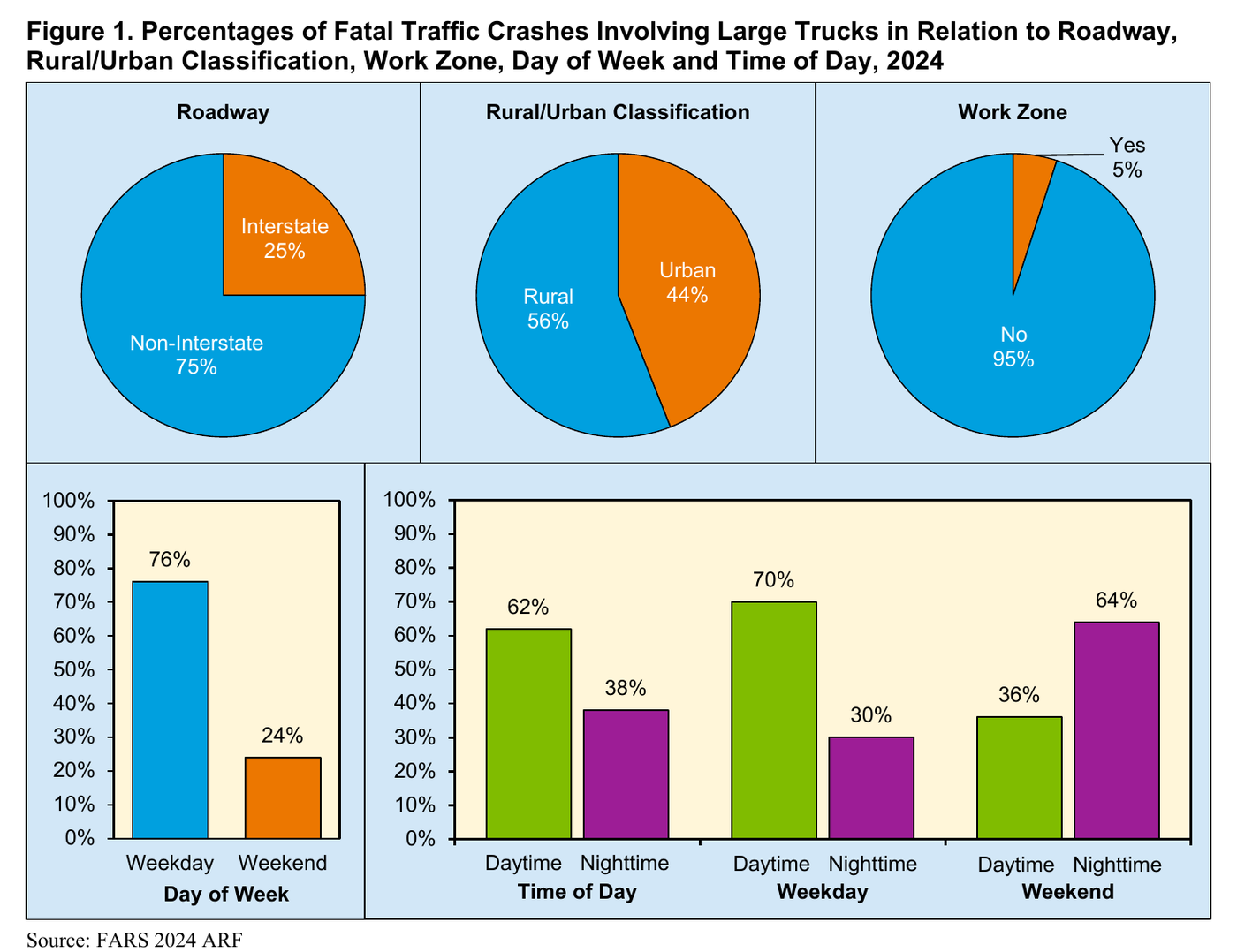
What days and hours are deadliest in Texas?
Friday is the deadliest day, and the 6 a.m. hour is the deadliest hour.
- Friday saw 17.0% of Texas fatal truck crashes in 2024, and Sunday the fewest at 9.0% (NHTSA FARS, Mar 2026).
- 78% of Texas fatal truck crashes happened Monday through Friday (NHTSA FARS, Mar 2026).
- Nationally, 76% of fatal truck crashes happened on weekdays, and 70% of those weekday crashes happened in daylight (NHTSA, Jun 2026).
- The 6 a.m. hour was the single deadliest hour in Texas, with 6.8% of fatal truck crashes (NHTSA FARS, Mar 2026).
- May was the deadliest month, with 68 fatal truck crashes in Texas (NHTSA FARS, Mar 2026).
Is bad weather to blame?
Rarely. Most fatal truck crashes happen on clear days, which points to driving and equipment rather than weather.
- 75% of Texas fatal truck crashes happened in clear weather and 8% in rain (NHTSA FARS, Mar 2026).
Which Texas roads see the most fatal truck crashes?
Mostly rural state and U.S. highways, not interstates.
- 55.8% of Texas fatal truck crashes happened in rural areas (NHTSA FARS, Mar 2026).
- Only 23.2% happened on interstates, while state and U.S. highways together accounted for 51.8% (NHTSA FARS, Mar 2026). Oilfield routes have their own story in our Permian Basin analysis.
- 7.9% of Texas fatal truck crashes (51) happened in work zones (NHTSA FARS, Mar 2026), against 5% nationally (NHTSA, Jun 2026).
How do these crashes happen?
Angle crashes and rear-end crashes top the list, and head-on crashes kill more people than most drivers expect.
- In Texas, 28.1% of fatal truck crashes were angle collisions, 22.6% front-to-rear and 13.8% head-on (NHTSA FARS, Mar 2026). See our guide to rear-end truck crashes.
- In two-vehicle fatal crashes nationwide, the truck was hit in the rear 22.1% of the time, three times the rate for the other vehicle (6.8%) (NHTSA, Jun 2026).
- 80% of large trucks in fatal crashes were in multivehicle crashes, compared with 63% of passenger vehicles (NHTSA, Jun 2026).
How often do crash records point to the truck driver or the carrier?
A trucking company chooses who drives, how long they drive and how hard they're pushed. The federal record shows those choices show up in crash data.
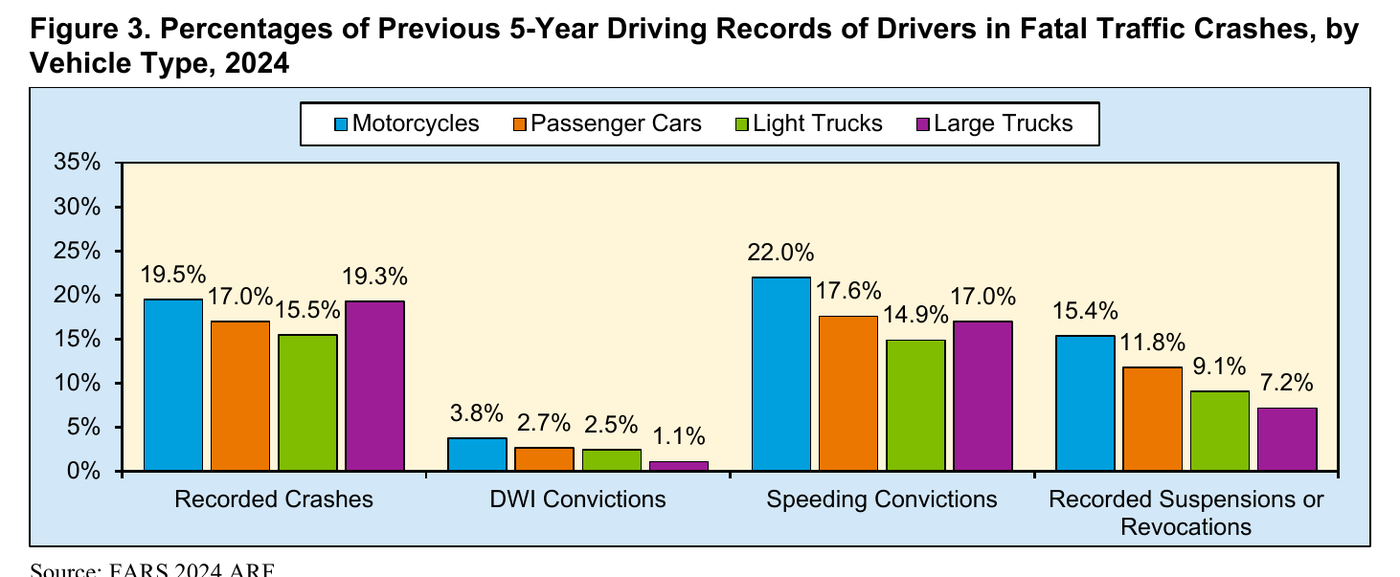
Do truck drivers in fatal crashes have bad driving records?
Many do, and carriers can check before they hire.
- 17.0% of large-truck drivers in fatal crashes had at least one speeding conviction in the prior five years (NHTSA, Jun 2026).
- In Texas, 19.3% of truck drivers in fatal crashes had a prior speeding conviction and 16.5% a prior recorded crash (NHTSA FARS, Mar 2026).
- Alcohol is rarely the issue: 4% of truck drivers in fatal crashes were alcohol-impaired, against 25% of passenger car drivers (NHTSA, Jun 2026).
What did federal crash investigators find?
The largest federal study of truck crash causes, using 2001 to 2003 data, found the truck at fault more often than not across all crash types.
- The truck was assigned the main reason for the crash in 55% of studied crashes (FMCSA, Jul 2007).
- In crashes between one truck and one car, the truck was assigned the main reason in 44% and the car in 56%, so fault in a two-vehicle crash is genuinely contested. Texas's comparative fault rules decide what that means for you (FMCSA, Mar 2006).
- When the truck was assigned the main reason, driver errors accounted for 87.2% of those cases (FMCSA, Mar 2006).
- "Traveling too fast for conditions" was coded for 22.9% of trucks (FMCSA, Mar 2006).
- In truck and car crashes, truck drivers were coded as driving too fast for conditions 15.2% of the time, against 10.4% for car drivers (FMCSA, Mar 2006).
- 13% of truck drivers were coded as fatigued at the time of the crash (FMCSA, Mar 2006). More on proving it: when a truck driver falls asleep.
- In truck and car crashes, car drivers were coded as fatigued more often (14.7%) than truck drivers (7.5%) (FMCSA, Mar 2006).
- 21.6% of truck drivers were unfamiliar with the roadway, having driven it fewer than six times in six months (FMCSA, Mar 2006).
- Prescription drug use was coded for 26.3% of truck drivers (FMCSA, Mar 2006).
- Aggressive driving such as tailgating or weaving was coded for 6.6% of trucks (FMCSA, Mar 2006).
How long can a trucker legally drive, and do they follow the rules?
Federal rules cap driving time, and inspectors keep catching drivers who break them. See how FMCSA rules work in a Texas case.
- A truck driver may drive up to 11 hours after 10 consecutive hours off duty (Code of Federal Regulations, Oct 2024).
- Drivers may not drive after 60 on-duty hours in 7 days or 70 hours in 8 days (Code of Federal Regulations, Oct 2024).
- Hours-of-service violations were the second most common reason U.S. drivers were pulled off the road in the 2026 Roadcheck, with 883 out-of-service violations (CVSA, Aug 2026).
- Inspectors found 214 U.S. drivers with false logbooks (CVSA, Aug 2026).
- Inspectors issued 146 out-of-service orders for tampering with electronic logging devices (CVSA, Aug 2026).
- 614 U.S. drivers were placed out of service for having no commercial driver's license (CVSA, Aug 2026).
What do Texas fatal crash reports show about truck behavior?
- 12.4% of trucks in Texas fatal crashes were coded as speeding-related, most often driving too fast for conditions (NHTSA FARS, Mar 2026).
- 16.3% of trucks in Texas fatal crashes (114) rolled over (NHTSA FARS, Mar 2026). See truck rollover crashes.
- 19 tractor-trailers jackknifed in Texas fatal crashes, and at least 35 crashes involved a car sliding under or a truck riding over another vehicle (NHTSA FARS, Mar 2026).
If a truck hit you, the driver's logs, electronic logging data and hiring file are evidence, and carriers don't have to keep all of it forever. A spoliation letter sent early can stop that evidence from disappearing. Sgt. Pike's team can send one this week through a free case review.
How many trucks fail safety inspections?
Roadside inspections are the closest thing to a random audit of the trucks you drive beside. In 2026, nearly a quarter of trucks given a full inspection failed badly enough to be pulled off the road.
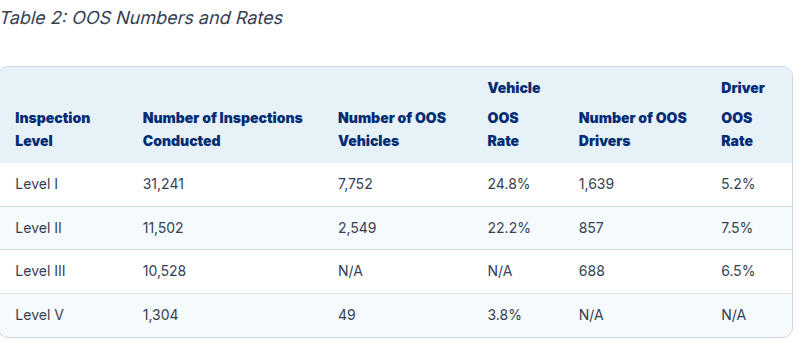
How many trucks are unsafe to drive?
About one in four in a full inspection.
- Full Level I inspections in the 2026 Roadcheck found a 24.8% vehicle out-of-service rate (CVSA, Aug 2026).
- Only 17,680 vehicles earned a CVSA decal for passing with zero serious violations (CVSA, Aug 2026).
- Inspectors conduct roughly 4 million commercial vehicle inspections across North America each year (CVSA, Oct 2025).
- In the 2026 hazmat enforcement blitz, 12.1% of U.S. hazmat vehicles inspected (500 of 4,122) were placed out of service (CVSA, Sep 2026). See tanker truck crashes.
- In Texas fatal crashes, 34 trucks caught fire and 22 were carrying hazardous materials (NHTSA FARS, Mar 2026).
Are brakes the biggest problem?
Yes, year after year.
- Brake systems were the top vehicle violation in the 2026 Roadcheck at 24.3% of vehicle out-of-service violations, and brake-related problems overall made up 39.1% (CVSA, Aug 2026).
- During Brake Safety Week 2025, 14.9% of U.S. trucks inspected had brake violations serious enough to take them off the road (CVSA, Oct 2025).
- 52.2% of those brake out-of-service violations involved trucks with 20% or more of their brakes defective (CVSA, Oct 2025).
- 4.7% of trucks tested on performance-based brake testers failed the federal minimum braking efficiency of 43.5% (CVSA, Oct 2025).
- The federal crash causation study coded brake problems for almost 30% of trucks in serious crashes (FMCSA, Mar 2006).
- In truck and car crashes, brake problems showed up on 27.0% of trucks but only 2.3% of cars (FMCSA, Mar 2006).
What else gets drivers and loads pulled off the road?
- No medical certificate was the top reason U.S. drivers were placed out of service in the 2026 Roadcheck, at 28.2% of driver violations (CVSA, Aug 2026).
- 361 U.S. drivers were placed out of service for failing English proficiency requirements (CVSA, Aug 2026).
- Inspectors found 1,724 cargo securement violations serious enough to stop the truck (CVSA, Aug 2026).
You can check any Texas carrier's federal safety records with our free Texas motor carrier lookup. If the company that hit you has a history of failed inspections, that history can matter in your claim. Talk to Sgt. Pike's team for free.
Who gets hurt when a truck crashes?
The truck driver usually walks away. The people in the car usually don't. That imbalance is the single clearest fact in truck crash data.
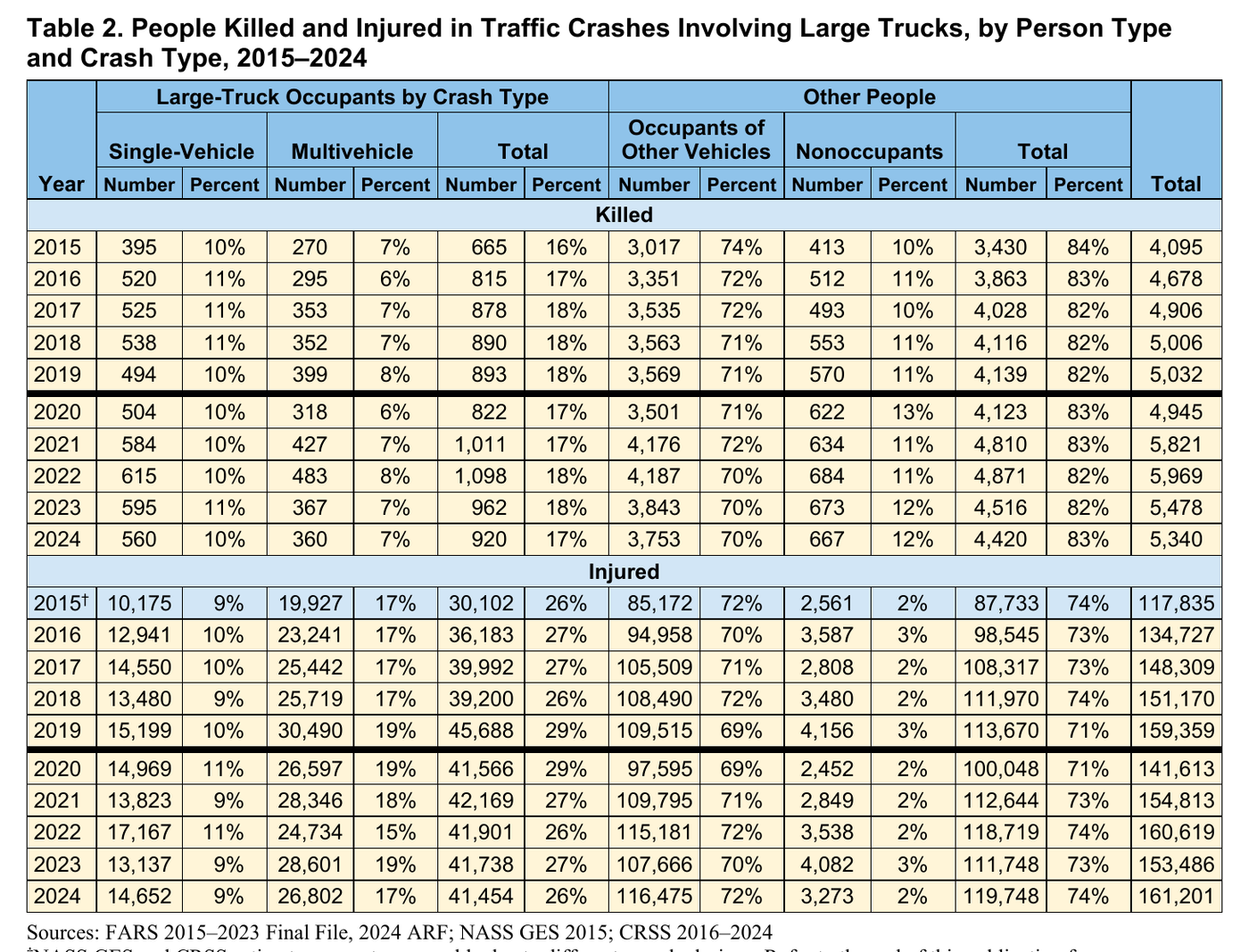
Who dies in truck crashes?
Mostly people in passenger vehicles, followed by pedestrians and cyclists.
- 70% of people killed in U.S. large-truck crashes in 2024 were in other vehicles, 3,753 people (NHTSA, Jun 2026).
- Texas led the nation with 73 pedestrians, cyclists and other people outside vehicles killed in truck crashes in 2024 (NHTSA, Jun 2026).
- 136 truck occupants died in Texas truck crashes, the most of any state; Florida was next with 42 (NHTSA, Jun 2026).
How many people are injured?
Far more people survive with injuries than die, and many of those injuries last a lifetime. See our pages on traumatic brain injury and wrongful death.
- 161,201 people were injured in U.S. large-truck crashes in 2024, up 5% from 2023 (NHTSA, Jun 2026).
- 72% of those injured, 116,475 people, were in other vehicles (NHTSA, Jun 2026).
- Texas commercial vehicle crashes left 1,611 people with suspected serious injuries in 2025, up from 1,601 in 2024 even as deaths fell (TxDOT, Apr 2026).
- Another 6,576 people had suspected minor injuries and 7,056 possible injuries in those crashes (TxDOT, Apr 2026).
- Texas crashes where a trailer heavily contributed caused 1,549 suspected serious injuries in 2025 (TxDOT, Apr 2026).
Are truck drivers at risk too?
Yes. Drivers are often victims of the same company decisions that endanger everyone else.
- Texas recorded 557 fatal work injuries in 2024, and 242 of them were transportation incidents (BLS, Feb 2026).
- 180 Texas workers in transportation and material moving jobs died on the job, 139 of them in transportation incidents (BLS, Feb 2026).
- Nationally, transportation and material moving workers suffered 1,391 fatal work injuries in 2024, the most of any job group, at 12.5 deaths per 100,000 full-time workers (BLS, Feb 2026).
- Transportation incidents caused 38.2% of all U.S. workplace deaths in 2024 (BLS, Feb 2026).
- A U.S. worker died from a work injury every 104 minutes in 2024 (BLS, Feb 2026).
What does a truck crash cost the people who are hit?
The costs land on the injured person and their family long before any insurer pays. Federal minimum insurance hasn't kept pace with what these crashes cost.
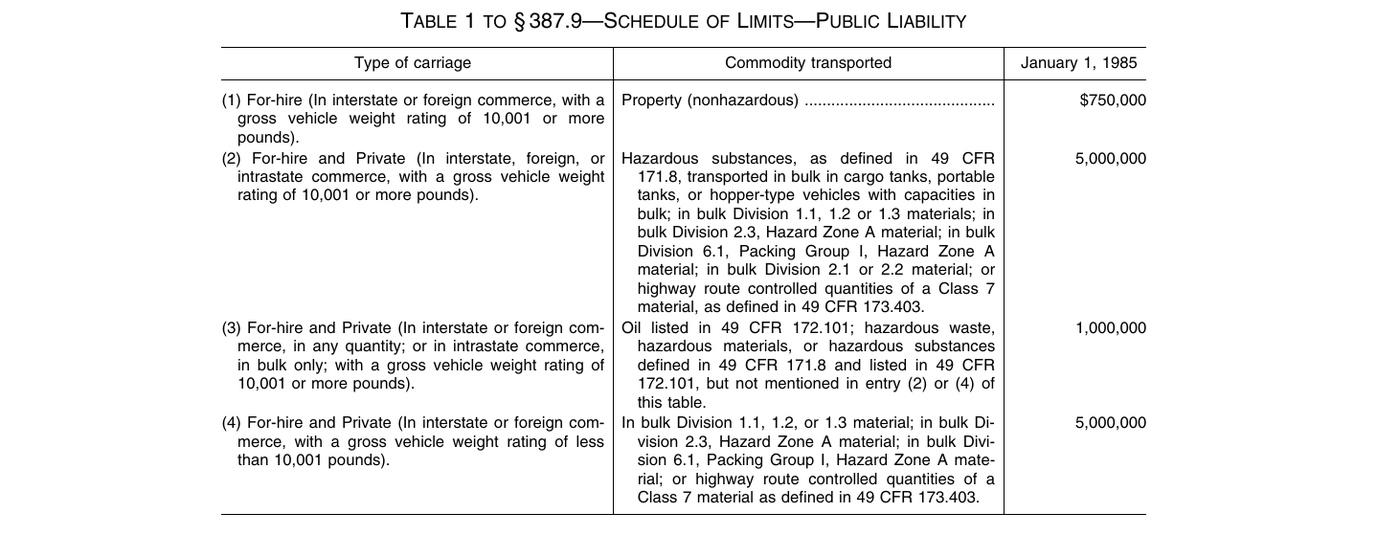
How much does a truck crash cost?
- One injury crash involving a large truck costs $326,810 and a non-injury crash $49,398, in 2023 dollars (FMCSA, Feb 2026).
- Across all commercial vehicles, the weighted cost of a fatal crash is $15,216,588 (FMCSA, Feb 2026).
What does a serious injury or death cost a family?
These NHTSA figures cover all crash types, in 2019 dollars.
- Each of the most severely injured crash survivors costs an average of $979,000 in economic losses, mostly medical care and lost work (NHTSA, Feb 2023).
- Each crash death carries a lifetime economic cost of $1.6 million, and $11.3 million once lost quality of life is counted (NHTSA, Feb 2023).
- Over 90% of the economic cost of a crash death comes from lost workplace and household productivity plus legal costs (NHTSA, Feb 2023).
How much insurance must a trucking company carry?
- Carriers hauling bulk hazardous materials must carry at least $5 million, and those hauling oil or hazardous waste at least $1 million (Code of Federal Regulations, Oct 2024). See Texas truck insurance minimums and why averages mislead.
How do Texas courts and laws treat truck crash victims?
Most truck crash claims never see a jury, and Texas law has made the ones that do harder to win. Knowing the rules early protects your claim.
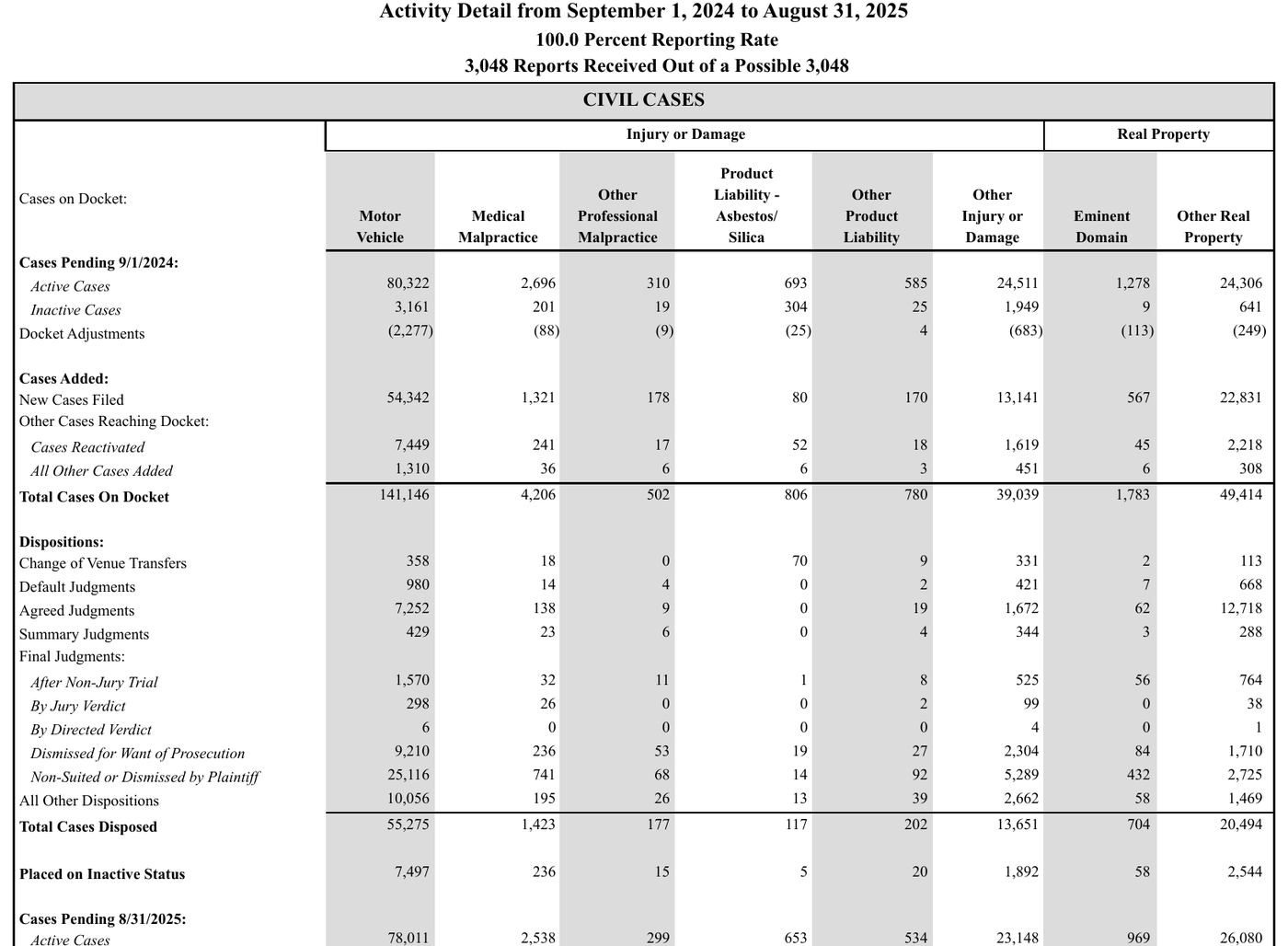
How many crash cases go to trial in Texas?
Very few. These counts cover all motor vehicle injury and damage cases, not only trucks.
- Plaintiffs filed 54,342 new motor vehicle injury and damage cases in Texas district courts in FY2025 (Texas Office of Court Administration, Dec 2025).
- 25,116 cases were nonsuited or dismissed by the plaintiff, often after settlement, and 7,252 ended in agreed judgments (Texas Office of Court Administration, Dec 2025).
- 78,011 motor vehicle cases were still active on Texas district court dockets on August 31, 2025 (Texas Office of Court Administration, Dec 2025).
What happened in Werner v. Blake?
The case shows how far a verdict can fall on appeal. In 2014, a pickup skidded across an icy I-20 median near Odessa into a Werner 18-wheeler.
- The Houston jury put 70% of the fault on Werner employees other than the driver, 14% on the truck driver and 16% on the pickup driver (Supreme Court of Texas, Jun 2025).
- The jury awarded $16,500,000 to the mother, $5,000,000 to one son and $68,187,994 to a daughter left quadriplegic (Supreme Court of Texas, Jun 2025).
What Texas laws shape a truck crash claim?
- You generally must file a personal injury or wrongful death lawsuit within two years (Texas Legislature, Oct 2026). See the Texas statute of limitations for truck crashes.
- If a jury finds you more than 50% responsible, you recover nothing (Texas Legislature, Sep 1995).
- Under the 2021 law known as HB 19, a trucking company can force a two-phase trial if it asks within 120 days of filing its answer (Texas Legislature, Sep 2021).
- If the company admits the driver was its employee acting on the job, HB 19 limits its liability for the driver's ordinary negligence to that employment link, which can keep hiring and training evidence out of the first phase (Texas Legislature, Sep 2021).
Are truck crash verdicts really growing?
The trucking industry says so. Its own research institute, ATRI, reported these figures, so weigh them with that in mind.
- ATRI counted 26 truck crash verdicts over $1 million in the first five years of its 2006 to 2019 data, and nearly 300 in the last five (ATRI, Jun 2020).
- ATRI found award sizes grew 51.7% a year from 2010 to 2018, while general inflation grew 1.7% (ATRI, Jun 2020).
Who answers when a self-driving truck crashes?
Self-driving trucks already run Texas freight lanes, but crash reporting is thin.
- Self-driving truck operators filed 7 Texas crash reports with NHTSA between April 2025 and August 2026, none reporting an injury. Every truck had a person on board or monitoring remotely (NHTSA, Aug 2026).
Deadlines, split trials and comparative fault can all shrink a claim before it starts. Sgt. Pike has handled truck cases in Texas for over 30 years. See recent case results or get a free case review.
Methodology and Sources
We built this page only from the organizations that produced each number: federal agencies (NHTSA, FMCSA, BLS), TxDOT, CVSA, the Code of Federal Regulations, Texas statutes, Texas courts, and one industry-funded study labeled as such. We don't cite statistics roundups or other law firms' pages. Texas-specific timing, road and vehicle figures marked "NHTSA FARS" are our analysis of NHTSA's 2024 Fatality Analysis Reporting System file, using NHTSA's large-truck body types. Our counts match NHTSA's published Texas totals of 699 trucks and 720 deaths. TxDOT counts all commercial motor vehicles (including buses), while NHTSA counts large trucks over 10,000 lb, so we label each and never combine them. The FMCSA crash causation study uses 2001 to 2003 data and is dated wherever we cite it. FMCSA pages were read through Internet Archive copies of the official pages because FMCSA's site blocks automated access. Statutes are dated to the effective date of the cited section, or to the month we read the current text. We review this page monthly and update it when a source publishes new data.
Glossary
- ATRI: American Transportation Research Institute, the trucking industry's research organization
- CDL: Commercial driver's license
- CMV: Commercial motor vehicle. TxDOT counts vehicles of 10,000 lb or more, hazmat carriers and vehicles carrying nine or more people
- CVSA: Commercial Vehicle Safety Alliance, the group that coordinates roadside inspection standards
- ELD: Electronic logging device, which records a driver's hours
- FARS: Fatality Analysis Reporting System, NHTSA's census of fatal crashes
- FMCSA: Federal Motor Carrier Safety Administration
- GVWR: Gross vehicle weight rating
- HB 19: The 2021 Texas law that changed how commercial vehicle crash lawsuits are tried
- HOS: Hours of service, the federal limits on driving and on-duty time
- LTCCS: Large Truck Crash Causation Study
- NHTSA: National Highway Traffic Safety Administration
- OOS: Out of service, meaning a truck or driver is barred from operating until the violation is fixed
- TxDOT: Texas Department of Transportation
Sources
- NHTSA, Large Trucks: 2024 Data (DOT HS 813 816)
- NHTSA, Fatality Analysis Reporting System 2024 national data file
- NHTSA, The Economic and Societal Impact of Motor Vehicle Crashes, 2019 (Revised), DOT HS 813 403
- NHTSA, Standing General Order crash reports, automated driving systems
- TxDOT, Commercial Motor Vehicle Involved Crashes and Injuries by County, 2025
- TxDOT, Commercial Motor Vehicle Involved Crashes and Injuries by County, 2024
- TxDOT, Trailer Involved Crashes and Injuries, 2025
- TxDOT, Trailer Involved Crashes and Injuries, 2024
- TxDOT, Count of Vehicles in Crashes by Body Style, 2025
- TxDOT, Texas Motor Vehicle Traffic Crash Facts, 2025
- FMCSA, Report to Congress on the Large Truck Crash Causation Study
- FMCSA, Large Truck Crash Causation Study Analysis Brief
- FMCSA, Crash Cost Methodology 2025
- CVSA, 2026 International Roadcheck Results
- CVSA, 2025 Brake Safety Week Results
- CVSA, 2026 Hazardous Materials/Dangerous Goods Road Blitz Results
- Code of Federal Regulations, 49 CFR 387.9, Financial responsibility, minimum levels
- Code of Federal Regulations, 49 CFR 395.3, Maximum driving time
- BLS, Census of Fatal Occupational Injuries Summary, 2024
- BLS, Fatal occupational injuries in Texas, 2024
- Texas Civil Practice and Remedies Code, Chapter 16
- Texas Civil Practice and Remedies Code, Chapter 33
- Texas Civil Practice and Remedies Code, Chapter 72
- Texas Office of Court Administration, District Courts Activity Detail, FY2025
- Supreme Court of Texas, Werner Enterprises, Inc. v. Blake, No. 23-0493, opinion
- Supreme Court of Texas, Werner Enterprises, Inc. v. Blake, No. 23-0493, opinion dissenting in part
- ATRI, New Research Documents the Scale of Nuclear Verdicts in the Trucking Industry

No fee unless we win.
Past results do not guarantee a similar outcome.