
Every figure links to the organization that produced it. We cite no other law firm's numbers.
Nobody counts car accident settlements. Most are private agreements between an injured person and an insurance company, and no agency collects the amounts. The closest thing to an official number is what insurers report paying: the average bodily injury liability claim was $28,278 in 2024 (Insurance Information Institute, from ISO data).
That average is pulled up by a small number of very large claims. In a survey of people who made car accident claims, the average payout was $23,900 and the median was about $8,200 (Martindale-Nolo Research, surveys from 2015 through 2020). Half of the people who were paid got less than the median.
This page lays out ten years of insurer claim data, the survey figures, what crash injuries cost, and the rules that cap what a claim can pay. A table for all 50 states and the District of Columbia gives each state's minimum insurance, fault rule and lawsuit deadline, with a link to the official source for each one. The page closes with a section on Texas, where we practice.
- The average paid bodily injury claim was $28,278 in 2024, up 66% from $17,014 in 2015 (Insurance Information Institute; the percentage is our calculation).
- The average property damage liability claim was $6,770 in 2024 (Insurance Information Institute).
- The median payout in survey data was about $8,200, roughly a third of the $23,900 average (Martindale-Nolo Research, 2015 to 2020).
- Injury claimants received $2.00 in total settlement for each dollar of medical bills paid, before legal fees (Insurance Research Council, Jul 2026).
- Injury claim payments grew 7.8% a year from mid-2017 to mid-2022, double the pace of medical care inflation (Insurance Research Council, Jul 2026).
- Texas requires $30,000 of injury coverage per person. A for-hire interstate freight truck must carry $750,000, which is 25 times as much (Texas Department of Insurance, Dec 2025; 49 CFR 387.9).
What is the average car accident settlement?
The best national measure is claim severity, the insurance industry's term for the average amount paid per claim. ISO, a unit of Verisk, collects it from insurers, and the Insurance Information Institute publishes it each year.
- The average bodily injury liability claim was $28,278 in 2024 (Insurance Information Institute).
- The average property damage liability claim was $6,770 (Insurance Information Institute).
- Insurers paid 0.80 bodily injury claims for every 100 insured cars in 2024, down from 0.89 in 2015. Property damage claims ran at 2.50 per 100 (Insurance Information Institute).
The figure has three limits. It counts paid claims at all policy limits combined. It includes the insurer's own cost of handling the claim, called loss adjustment expense. And the bodily injury series leaves out Massachusetts and most states with no-fault insurance laws, where a driver's own policy pays injury costs first.
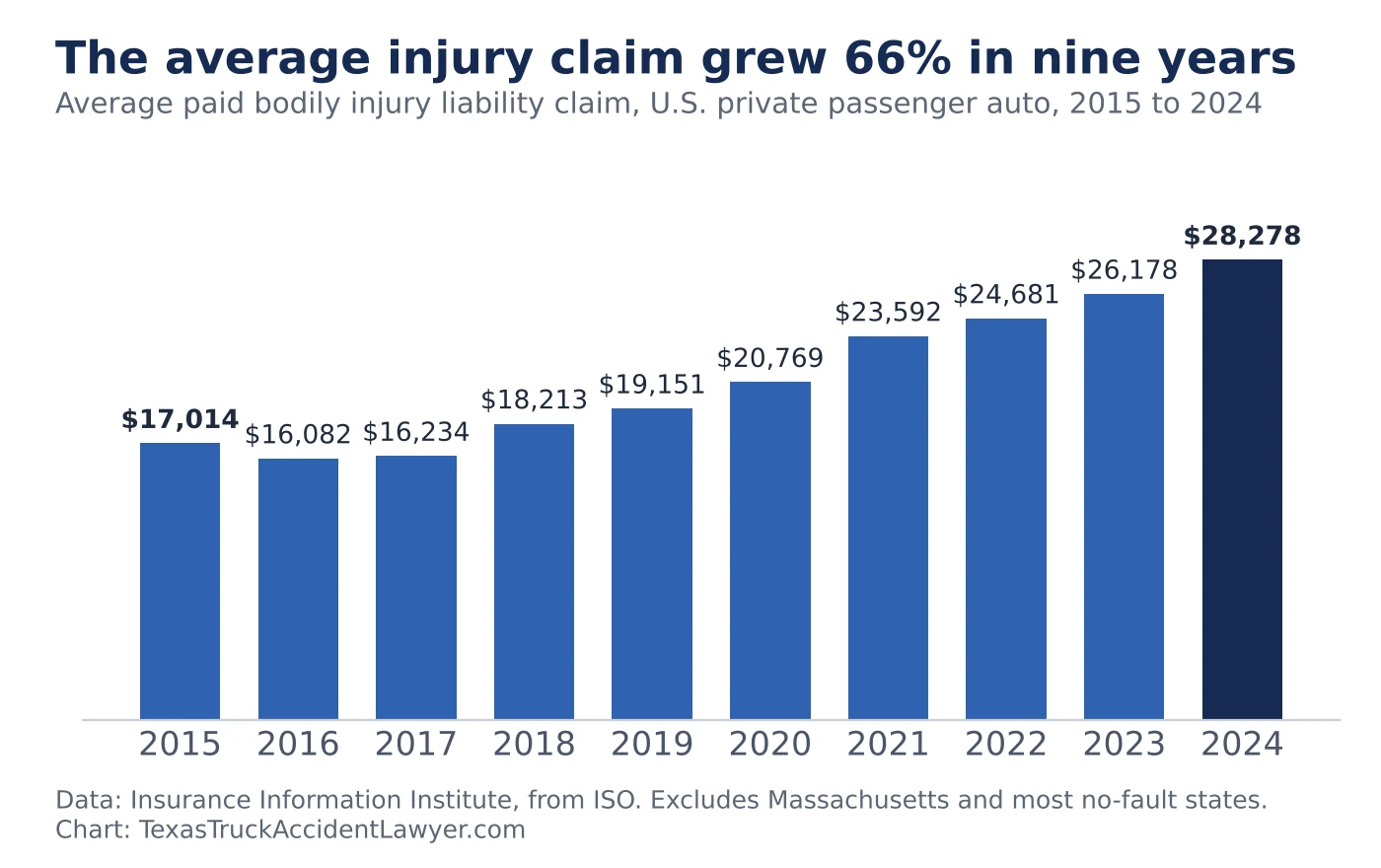
Average car accident claim by year, 2015 to 2024
| Year | Average bodily injury claim | Injury claims per 100 insured cars | Average property damage claim | Property damage claims per 100 insured cars |
|---|---|---|---|---|
| 2015 | $17,014 | 0.89 | $3,628 | 3.45 |
| 2016 | $16,082 | 1.04 | $3,969 | 3.41 |
| 2017 | $16,234 | 1.06 | $3,797 | 3.16 |
| 2018 | $18,213 | 0.94 | $4,174 | 3.09 |
| 2019 | $19,151 | 0.93 | $4,326 | 3.14 |
| 2020 | $20,769 | 0.78 | $4,703 | 2.39 |
| 2021 | $23,592 | 0.68 | $5,036 | 2.28 |
| 2022 | $24,681 | 0.70 | $6,024 | 2.54 |
| 2023 | $26,178 | 0.78 | $6,554 | 2.59 |
| 2024 | $28,278 | 0.80 | $6,770 | 2.50 |
Source: Insurance Information Institute, Facts + Statistics: Auto insurance, from ISO, a Verisk business. Read 23 Nov 2026. Paid claims, all limits combined. Liability figures include loss adjustment expenses. Frequency is claims per 100 earned car years, where one car year is one vehicle insured for 365 days. Bodily injury excludes Massachusetts and most no-fault states. Property damage excludes Massachusetts, Michigan and New Jersey.
Many pages quote $26,501 or $24,211 as the average injury claim. Neither figure appears in the current edition of the table, which shows $26,178 for 2023 and $24,681 for 2022.
How fast are car accident payouts growing?
Faster than medical costs. Insurers pay fewer injury claims per insured car than they did in 2015, and each one costs more.
- The average bodily injury claim rose 66% from 2015 to 2024, and 8% in the last year alone. Our calculation from the table above (Insurance Information Institute).
- The average property damage claim rose 87% over the same nine years, from $3,628 to $6,770. Our calculation (Insurance Information Institute).
- In a separate database of more than 7.4 million paid injury claims from nine insurers, average bodily injury payments grew 7.8% a year from mid-2017 through mid-2022, double the pace of medical care inflation (Insurance Research Council, Jul 2026).
- The share of bodily injury claimants who had an attorney reached 57% in 2022 (Insurance Research Council, Jul 2026).
The Insurance Research Council is an insurance industry research group and a division of The Institutes. The nine insurers in its database write about 43% of U.S. private passenger auto coverage.
Why is the average higher than what most people receive?
An average adds every payout together and divides by the number of claims, so one seven-figure injury claim outweighs hundreds of small ones. The median is the middle claim, with half above and half below, and it sits much lower.
The insurer data gives no median. Martindale-Nolo Research does. It surveyed readers of its legal websites about their car accident claims from 2015 through 2020:
- The average settlement or court award was $23,900.
- The median was about $8,200.
- 35% of readers received $5,000 or less, and 23% received $20,000 or more.
- People who were physically injured averaged $29,700. People who were not injured averaged $16,700.
- 98% of those who were paid got the money in a settlement and the rest in a court award.
Source: Martindale-Nolo Research, car accident claim surveys, 2015 through 2020, as published on Lawyers.com (updated Jan 2025). Respondents were site visitors who chose to take the survey, and the publisher does not state the sample size, so treat these as a guide to the shape of payouts and not as a national measurement.
How do settlements compare with medical bills?
A common rule of thumb says a settlement equals medical bills times some number between 1.5 and 5. A 2026 study of paid claims found the ratio near the bottom of that range.
- Bodily injury claimants received $2.00 in total settlement for each dollar of medical bills paid, before legal fees (Insurance Research Council, Jul 2026).
- That ratio rose from $1.80 in early 2018 to more than $2.30 by mid-2022 (Insurance Research Council, Jul 2026).
A ratio across millions of claims says little about any single one. A broken wrist with $9,000 in bills and a spinal injury with $9,000 in bills so far are different claims, because the second carries years of future care and lost income.
What does a crash injury cost?
A settlement is meant to repay losses, so the size of the loss sets the starting point. The National Safety Council estimates the average economic cost of a crash injury at each severity level police use on crash reports. These are costs per person hurt, and they are not settlement amounts.
| Injury severity on the crash report | Average economic cost, 2024 |
|---|---|
| Death (K) | $2,050,000 |
| Disabling injury (A) | $174,000 |
| Evident injury (B) | $45,000 |
| Possible injury (C) | $28,000 |
| No injury observed (O) | $7,700 |
| Property damage only, per vehicle | $6,600 |
Source: National Safety Council, Injury Facts, Costs of Motor-Vehicle Injuries, 2024 estimates. Economic cost covers wage and productivity losses, medical expenses, administrative expenses, motor-vehicle damage and employers' uninsured costs. It leaves out lost quality of life. NSC's comprehensive cost, which adds it, is $1,167,000 for a disabling injury and $14,393,000 for a death.
Texas crash reports use the same scale and write N where the national scale has an O. Our guide to Texas crash report codes shows where the injury severity code sits on the form.
What caps a car accident settlement?
Usually the at-fault driver's insurance. An insurer pays no more than the policy limit, so the at-fault driver's coverage is the first ceiling on a claim. Commercial trucks must carry far more than cars.
- Texas requires drivers to carry at least $30,000 of injury coverage per person, $60,000 per crash, and $25,000 for property damage (Texas Department of Insurance, Dec 2025).
- A for-hire truck rated at 10,001 pounds or more that hauls nonhazardous freight across state lines must carry at least $750,000 (49 CFR 387.9). That is 25 times the Texas per-person minimum for a car.
- Texas insurers must offer uninsured and underinsured motorist coverage, which pays when the other driver has no insurance or too little. A driver who does not want it must reject it in writing (Texas Department of Insurance, Dec 2025).
For truck claims, see how much insurance a truck must carry in Texas and what sets the range of a Texas truck accident settlement.
What are the insurance minimums, fault rules and deadlines in each state?
Three state rules shape most car accident claims. The minimum liability coverage is the least an at-fault driver's policy can pay. The fault rule decides whether an injured person who shares the blame is paid less or nothing. The deadline is how long that person has to file a lawsuit.
Each cell below links to the state statute, agency or court source where we read it. Limits are in thousands of dollars: 25/50/25 means $25,000 for one person's injuries, $50,000 for all injuries in one crash, and $25,000 for property damage.
| State | Minimum liability limits | Fault rule: what you recover if you share the blame | Lawsuit deadline for injuries |
|---|---|---|---|
| Alabama | 25/50/25 (Alabama Department of Revenue, citing Ala. Code 32-7-6) | Nothing if you were at fault to any degree. (Campbell v. Kennedy, No. 1160444 (Ala. Oct. 26, 2018)) | 2 years (Ala. Code 6-2-38(l), as stated in Ex parte Abbott Laboratories (Ala. May 28, 2021)) |
| Alaska | 50/100/25 (AS 28.22.101) | Reduced by your share of fault, with no cutoff. (AS 09.17.060) | 2 years (AS 09.10.070) |
| Arizona | 25/50/15 (A.R.S. 28-4009) | Reduced by your share of fault, with no cutoff. (A.R.S. 12-2505) | 2 years (A.R.S. 12-542) |
| Arkansas | 25/50/25 (Arkansas Insurance Department, Automobile Insurance brochure) | Reduced by your share of fault. Nothing if you are 50% or more at fault. (Ark. Code 16-64-122, as stated in Belcher v. Denton, 2016 Ark. App. 263) | 3 years (Ark. Code 16-56-105, as stated in Early v. Baker, 2013 Ark. 511) |
| California | 30/60/15 (California DMV, citing Ins. Code 11580.1b) | Reduced by your share of fault, with no cutoff. (Judicial Council of California, CACI No. 405 (Li v. Yellow Cab Co., 1975)) | 2 years (California Courts Self-Help Guide) |
| Colorado | 25/50/15 (C.R.S. 10-4-620) | Reduced by your share of fault. Nothing if you are 50% or more at fault. (C.R.S. 13-21-111) | 3 years (C.R.S. 13-80-101(1)(n)) |
| Connecticut | 25/50/25 (Connecticut Insurance Department) | Reduced by your share of fault. Nothing if you are more than 50% at fault. (C.G.S. 52-572h) | 2 years from discovery, and no more than 3 from the crash (C.G.S. 52-584) |
| Delaware | 25/50/10 (21 Del. C. 2902) | Reduced by your share of fault. Nothing if you are more than 50% at fault. (10 Del. C. 8132) | 2 years (10 Del. C. 8119) |
| District of Columbia | 25/50/10 (D.C. Code 31-2406) | Nothing if you were at fault to any degree. Pedestrians and other vulnerable road users have a statutory exception. (D.C. Code 50-2204.52) | 3 years (D.C. Code 12-301) |
| Florida | No injury coverage required to register a car. $10,000 property damage. (Fla. Stat. 324.022 and 324.021(7)) | Reduced by your share of fault. Nothing if you are more than 50% at fault. (Fla. Stat. 768.81(6)) | 2 years (Fla. Stat. 95.11) |
| Georgia | 25/50/25 (Georgia Office of Commissioner of Insurance) | Reduced by your share of fault. Nothing if you are 50% or more at fault. (O.C.G.A. 51-12-33(g), as quoted in Alston & Bird v. Hatcher Management Holdings, 312 Ga. 350 (2021)) | 2 years (O.C.G.A. 9-3-33, as quoted in Doe v. Saint Joseph's Catholic Church, 313 Ga. 558 (2022)) |
| Hawaii | 40/80/20 (policies effective Jan 1, 2026 or later) (HRS 431:10C-301) | Reduced by your share of fault. Nothing if you are more than 50% at fault. (HRS 663-31) | 2 years (HRS 657-7) |
| Idaho | 25/50/15 (Idaho Code 49-117) | Reduced by your share of fault. Nothing if you are 50% or more at fault. (Idaho Code 6-801) | 2 years (Idaho Code 5-219) |
| Illinois | 25/50/20 (625 ILCS 5/7-203) | Reduced by your share of fault. Nothing if you are more than 50% at fault. (735 ILCS 5/2-1116, as stated in Illinois Pattern Jury Instructions, Civil, 10.00 and B10.03) | 2 years (735 ILCS 5/13-202) |
| Indiana | 25/50/25 (Indiana Bureau of Motor Vehicles) | Reduced by your share of fault. Nothing if you are more than 50% at fault. (Indiana Comparative Fault Act, as stated in Davidson v. State, No. 22S-CT-318 (Ind. June 21, 2023)) | 2 years (Ind. Code 34-11-2-4(a)(1), as stated in Obregon v. Klisurich, No. 21A-CT-1335 (Ind. Ct. App. Jan. 20, 2022)) |
| Iowa | 20/40/15 (Iowa Code 321A.21) | Reduced by your share of fault. Nothing if you are more than 50% at fault. (Iowa Code 668.3) | 2 years (Iowa Code 614.1(2)) |
| Kansas | 25/50/25 (K.S.A. 40-3107) | Reduced by your share of fault. Nothing if you are 50% or more at fault. (K.S.A. 60-258a) | 2 years (K.S.A. 60-513) |
| Kentucky | 25/50/25 (KRS 304.39-110) | Divided by each party's percentage of fault. The statute sets no cutoff. (KRS 411.182) | 2 years from the injury or the last no-fault benefit payment, whichever is later (KRS 304.39-230) |
| Louisiana | 15/30/25 (La. R.S. 32:900) | Reduced by your share of fault. Nothing if you are more than 50% at fault. (La. Civ. Code art. 2323) | 2 years (crashes on or after July 1, 2024) (La. Civ. Code art. 3493.1) |
| Maine | 50/100/25 (29-A M.R.S. 1605) | Reduced by your share of fault. Nothing if you are 50% or more at fault. (14 M.R.S. 156) | 6 years (14 M.R.S. 752) |
| Maryland | 30/60/15 (Md. Transp. 17-103) | Nothing if you were at fault to any degree. (Coleman v. Soccer Association of Columbia, No. 9, Sept. Term 2012 (Md. July 9, 2013)) | 3 years (Md. Cts. & Jud. Proc. 5-101) |
| Massachusetts | 25/50/30 (M.G.L. c. 90, 34A and 34O) | Reduced by your share of fault. Nothing if you are more than 50% at fault. (M.G.L. c. 231, 85) | 3 years (M.G.L. c. 260, 2A) |
| Michigan | 250/500/10 by default. A driver may choose injury limits as low as 50/100. (MCL 500.3009(1) and (5)) | Reduced by your share of fault. Above 50%, no noneconomic damages. (MCL 600.2959) | 3 years (MCL 600.5805) |
| Minnesota | 30/60/10 (Minn. Stat. 65B.49 subd. 3) | Reduced by your share of fault. Nothing if you are more than 50% at fault. (Minn. Stat. 604.01) | 6 years (Minn. Stat. 541.05) |
| Mississippi | 25/50/25 (Mississippi Insurance Department) | Reduced by your share of fault, with no cutoff. (Miss. Code 11-7-15, as quoted in Howarth v. M & H Ventures, No. 2016-CA-00742-SCT (Miss. Nov. 2, 2017)) | 3 years (Miss. Code 15-1-49, as stated in Clearman v. Pipestone Property Services, No. 2022-CA-00651-COA (Miss. Ct. App. Nov. 21, 2023)) |
| Missouri | 25/50/25 (RSMo 303.190) | Reduced by your share of fault, with no cutoff. (Missouri Approved Instructions, Civil, 37.00 comment (Gustafson v. Benda, 1983), Supreme Court of Missouri order of Nov. 7, 2017) | 5 years (RSMo 516.120) |
| Montana | 25/50/20 (MCA 61-6-103) | Reduced by your share of fault. Nothing if you are more than 50% at fault. (MCA 27-1-702) | 3 years (MCA 27-2-204) |
| Nebraska | 25/50/25 (Neb. Rev. Stat. 60-310) | Reduced by your share of fault. Nothing if you are 50% or more at fault. (Neb. Rev. Stat. 25-21,185.09) | 4 years (Neb. Rev. Stat. 25-207) |
| Nevada | 25/50/20 (NRS 485.185) | Reduced by your share of fault. Nothing if you are more than 50% at fault. (NRS 41.141) | 2 years (NRS 11.190(4)(e)) |
| New Hampshire | 25/50/25 when a policy is bought. Insurance is not required of every driver. (RSA 259:61) | Reduced by your share of fault. Nothing if you are more than 50% at fault. (RSA 507:7-d) | 3 years (RSA 508:4) |
| New Jersey | 35/70/25 on a standard policy (since Jan 1, 2026). A basic policy has no injury liability coverage unless added. (N.J. Department of Banking and Insurance, Bulletin No. 25-06 (N.J.S.A. 39:6B-1)) | Reduced by your share of fault. Nothing if you are more than 50% at fault. (N.J.S.A. 2A:15-5.1, as quoted in Goldhagen v. Pasmowitz (N.J. Aug. 5, 2021)) | 2 years (N.J.S.A. 2A:14-2, as amended by P.L. 2019, c. 120) |
| New Mexico | 25/50/10 (New Mexico Motor Vehicle Division) | Reduced by your share of fault, with no cutoff. (Scott v. Rizzo, 1981-NMSC-021, as stated in Torres v. El Paso Electric Co., 1999-NMSC-029) | 3 years (NMSA 1978, 37-1-8) |
| New York | 25/50/10 (50/100 for a death) (N.Y. Veh. & Traf. Law 311(4)) | Reduced by your share of fault, with no cutoff. (CPLR 1411) | 3 years (CPLR 214) |
| North Carolina | 50/100/50 (G.S. 20-279.21) | Nothing if your own negligence contributed to the injury, with narrow exceptions. (Cullen v. Logan Developers, Inc., No. 155PA23 (N.C. Aug. 23, 2024)) | 3 years (G.S. 1-52) |
| North Dakota | 25/50/25 (N.D.C.C. 39-16.1-11) | Reduced by your share of fault. Nothing if you are 50% or more at fault. (N.D.C.C. 32-03.2-02) | 6 years (N.D.C.C. 28-01-16) |
| Ohio | 25/50/25 (R.C. 4509.51) | Reduced by your share of fault. Nothing if you are more than 50% at fault. (R.C. 2315.33) | 2 years (R.C. 2305.10) |
| Oklahoma | 25/50/25 (47 O.S. 7-324) | Reduced by your share of fault. Nothing if you are more than 50% at fault. (23 O.S. 13 and 14) | 2 years (12 O.S. 95(A)(3)) |
| Oregon | 25/50/20 (ORS 806.070) | Reduced by your share of fault. Nothing if you are more than 50% at fault. (ORS 31.600) | 2 years (ORS 12.110) |
| Pennsylvania | 15/30/5 (75 Pa.C.S. 1702) | Reduced by your share of fault. Nothing if you are more than 50% at fault. (42 Pa.C.S. 7102) | 2 years (42 Pa.C.S. 5524) |
| Rhode Island | 25/50/25 (R.I. Gen. Laws 31-47-2) | Reduced by your share of fault, with no cutoff. (R.I. Gen. Laws 9-20-4) | 3 years (R.I. Gen. Laws 9-1-14) |
| South Carolina | 25/50/25 (S.C. Code 38-77-140) | Reduced by your share of fault. Nothing if you are more than 50% at fault. (Nelson v. Concrete Supply Co. (S.C. 1991), as stated in Berberich v. Jack, Op. No. 26955 (S.C. Apr. 4, 2011)) | 3 years (S.C. Code 15-3-530) |
| South Dakota | 25/50/25 (SDCL 32-35-70) | Recovery only if your fault was slight compared with the other side's. (SDCL 20-9-2) | 3 years (SDCL 15-2-14) |
| Tennessee | 25/50/25 (Tennessee Department of Safety and Homeland Security) | Reduced by your share of fault. Nothing if you are 50% or more at fault. (McIntyre v. Balentine (Tenn. 1992), as stated in McNabb v. Highways, Inc., No. E2001-00867-SC-R11-CV (Tenn. Mar. 3, 2003)) | 1 year (Tenn. Code 28-3-104(a)(1), as stated in Peterson v. Carey, No. E2022-01656-COA-R3-CV (Tenn. Ct. App. Oct. 23, 2023)) |
| Texas | 30/60/25 (Texas Department of Insurance) | Reduced by your share of fault. Nothing if you are more than 50% at fault. (Tex. Civ. Prac. & Rem. Code 33.001) | 2 years (Tex. Civ. Prac. & Rem. Code 16.003) |
| Utah | 30/65/25 (Utah Code 31A-22-304) | Reduced by your share of fault. Nothing if you are 50% or more at fault. (Utah Code 78B-5-818) | 4 years (Utah Code 78B-2-307) |
| Vermont | 25/50/10 (23 V.S.A. 800) | Reduced by your share of fault. Nothing if you are more than 50% at fault. (12 V.S.A. 1036) | 3 years (12 V.S.A. 512) |
| Virginia | 50/100/25 (Va. Code 46.2-472) | Nothing if you were at fault to any degree. (AlBritton v. Commonwealth, Record No. 191030 (Va. Feb. 4, 2021)) | 2 years (Va. Code 8.01-243) |
| Washington | 25/50/10 (RCW 46.29.090) | Reduced by your share of fault, with no cutoff. (RCW 4.22.005) | 3 years (RCW 4.16.080) |
| West Virginia | 25/50/25 (W. Va. Code 17D-4-2) | Reduced by your share of fault. Nothing if you are more than 50% at fault. (W. Va. Code 55-7-13c) | 2 years (W. Va. Code 55-2-12) |
| Wisconsin | 25/50/10 (Wisconsin Office of the Commissioner of Insurance, PI-057 (Oct 2026)) | Reduced by your share of fault. Nothing if you are more than 50% at fault. (Wis. Stat. 895.045(1)) | 3 years (2 for a death) (Wis. Stat. 893.54) |
| Wyoming | 25/50/20 (Wyo. Stat. 31-9-405) | Reduced by your share of fault. Nothing if you are more than 50% at fault. (Wyo. Stat. 1-1-109) | 4 years (Wyo. Stat. 1-3-105) |
Read November 23, 2026. All 153 cells were confirmed in a state statute, a state agency page or a state court source. Where a state's rule comes from court decisions, the link goes to a court opinion, a pattern jury instruction or an agency page that states it. Florida and New Hampshire do not require every driver to carry injury liability coverage. In no-fault states, a driver's own policy pays injury costs first. Deadlines have exceptions, and claims that involve a death, a minor or a government body often follow different rules. Several states changed these rules recently: New Jersey and Hawaii raised their minimum limits on January 1, 2026, and Louisiana's two-year deadline applies to crashes on or after July 1, 2024. This table is general information and not legal advice.
What is the average car accident settlement in Texas?
Texas does not publish one. The Texas Department of Insurance reports premiums, policy counts and total losses paid each year, and its annual market report contains no average claim amount. The Texas dollar ranges we found on other law firm pages name no state source.
Here is what the state does report:
- Insurers paid $12.74 billion in losses on private passenger auto liability coverage in Texas's voluntary market in 2025, up 3.8% from $12.27 billion in 2024 (Texas Department of Insurance, Mar 2026; the percentage is our calculation).
- Those liability losses were 62% higher than in 2019, when insurers paid $7.89 billion. Our calculation (Texas Department of Insurance, Mar 2026).
- Insurers wrote 17,955,698 private passenger auto liability policies in Texas in 2025 (Texas Department of Insurance, Mar 2026).
Texas rules that change the number
- A person who is more than 50% responsible for the crash recovers nothing (Civil Practice and Remedies Code § 33.001).
- At 50% or less, the court reduces the damages by that person's percentage of responsibility (§ 33.012). Someone found 20% responsible for $100,000 in damages recovers $80,000.
- Recovery of medical expenses is limited to the amount actually paid or incurred by or on behalf of the injured person (§ 41.0105). When a health insurer paid a reduced rate, the reduced amount is what can be recovered.
- A personal injury lawsuit must be filed within two years of the day the claim accrues, which is normally the day of the crash (§ 16.003).
- Every Texas auto policy includes personal injury protection unless the driver declines it in writing. It pays medical bills and lost wages for the driver and passengers (Texas Department of Insurance, Dec 2025).
More on these rules: is Texas a no-fault state, recovering when you were partly at fault, and the Texas filing deadline.
How long does a settlement take, and is it taxed?
- People with successful car accident claims waited an average of 10.7 months for payment (Martindale-Nolo Research, 2015 to 2020).
- Damages received on account of personal physical injuries or physical sickness are excluded from gross income under Internal Revenue Code Section 104(a)(2), including the part paid for lost wages (IRS, Oct 2026).
- Punitive damages are generally taxable, and so are emotional distress damages that do not stem from a physical injury (IRS, Oct 2026).
Use the chart or cite this page
The chart is free to republish with a link to this page.
Methodology and sources
We used only the organization that produced each number, read on November 23, 2026. Insurer claim figures are from the Insurance Information Institute's table of ISO data. Growth percentages are our arithmetic from that table and from the Texas Department of Insurance's annual experience table, and each one is marked as our calculation. Texas law is quoted from the statutes. For the state table, we read each state's minimum limits, fault rule and lawsuit deadline in that state's own statute, agency page or court source, and left a cell blank when we could not. The one source without a link is the Martindale-Nolo Research survey, which we name in the text.
“Settlement” and “claim” are different measurements. The insurer data counts paid liability claims and includes the insurer's handling costs. It does not subtract attorney fees, medical liens or case expenses, so it is more than a claimant keeps. The survey counts what readers said they received.
- Insurance Information Institute, Facts + Statistics: Auto insurance, table “Private Passenger Auto Insurance Losses, 2015-2024” (source: ISO, a Verisk business)
- Insurance Research Council, Auto Injury Insurance Claims: A Study of Increasing Claim Severity, summary, July 2026
- National Safety Council, Injury Facts, Costs of Motor-Vehicle Injuries, 2024 estimates
- Texas Department of Insurance, 2025 Market Conditions Annual Report, March 2026, pages 5 and 20
- Texas Department of Insurance, Auto insurance guide, updated December 11, 2025
- Internal Revenue Service, Tax implications of settlements and judgments, reviewed October 9, 2026
- 49 CFR 387.9, Financial responsibility, minimum levels, eCFR
- Texas Civil Practice and Remedies Code § 33.001 and § 33.012, proportionate responsibility
- Texas Civil Practice and Remedies Code § 41.0105, evidence relating to amount of economic damages
- Texas Civil Practice and Remedies Code § 16.003, two-year limitations period
- State statutes, insurance and motor vehicle agencies, and court sources for the state table. Each state's source is linked in its row.
- Martindale-Nolo Research, car accident claim surveys, 2015 through 2020, published on Lawyers.com, updated January 21, 2025
This page is general information and not legal or tax advice. Past figures do not predict the value of any claim.
Hurt in a crash in Texas? Sgt. Pike has more than 30 years of experience. Get a free case review, or call or text (832) 250-4888.

 Army Green Beret
Find out for free. Ethan from Sgt. Pike's team calls you within 5 minutes.
Past results do not guarantee a similar outcome.
“Texas Truck Accident Lawyer was a huge help after an 18-wheeler rear ended me. They explained every step clearly and made sure I understood my options. The entire team was supportive and easy to work with.”
“The team at Texas truck accident lawyer was very respectful and impressive, they listened to my issue without making me feel like a burden”