
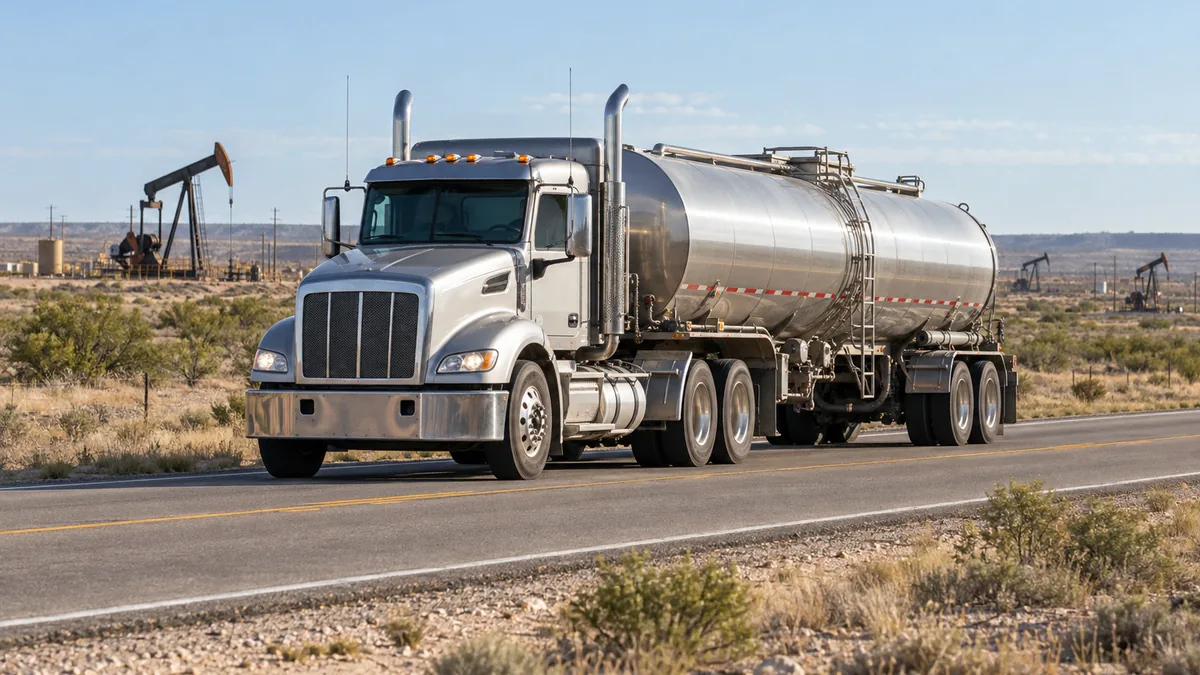
Quick answer: Oilfield truck crashes differ from ordinary highway wrecks in three ways. The traffic is heavier and stranger: sand, water, and crude haulers running around the clock on two-lane farm roads built for ranch traffic. The rules are different: federal law gives oilfield operations their own hours-of-service provisions, and whether they applied is a fact question. And the defendants multiply: the carrier, the well operator, a staffing company, and a broker may all share responsibility. TxDOT's 2025 data shows why it matters: Midland and Ector counties each recorded a commercial vehicle fatality rate per crash roughly three times or more that of Harris County.
What Makes Permian Basin Truck Traffic Different?
The Permian Basin is the most productive oil field in the country, and its product moves on rubber. A single well can demand hundreds of truckloads of sand, water, pipe, and equipment before it produces a barrel, and then the crude itself rides out in tankers. That traffic does not stay on I-20. It cuts between lease roads and highways on farm-to-market routes with narrow lanes and soft shoulders, at all hours, driven by people working oilfield schedules.
Our Midland-Odessa truck accident page maps the corridors where this traffic concentrates: I-20 through both cities, SH 191 between them, SH 349 south toward the producing country, FM 1788 running between highway and lease, and the loops around each city. The pattern in the wrecks follows the pattern in the traffic: head-on and lane-departure crashes on the two-lane roads, speed-differential collisions where lease traffic meets through traffic, and tanker rollovers where a shifting liquid load meets a curve taken too fast.
What Do the 2025 Crash Numbers Show?
TxDOT's 2025 CMV crash data, which we break down for all 254 counties in our Texas truck accident statistics by county reference, puts numbers on the basin's reputation:
- Midland County: 536 commercial vehicle crashes, 11 of them fatal, killing 11 people. That is 2.05 fatal crashes per 100 CMV crashes.
- Ector County: 379 crashes, 9 fatal, 9 deaths, a rate of 2.37 fatal crashes per 100.
- Martin County, on the highway north toward Lubbock: 118 crashes with 4 fatal crashes, a rate of 3.39 per 100.
- Reeves County, in the Delaware Basin to the west: 167 crashes, 3 fatal.
The totals look small next to Harris County's 5,913 crashes, but the severity runs the other way. Harris County's fatal-crash rate was 0.69 per 100 CMV crashes in the same data. Midland's was roughly three times or more that, Ector's higher still, and rural basin counties like Martin ran higher again. When a heavy truck hits something out here, the crash is far more likely to kill, because it happens at highway speed on a road with no divider and the trauma care is an hour away.
Do Oilfield Trucks Follow Different Hours-of-Service Rules?
Partly, and the details matter. The federal hours-of-service rules cap how long a commercial driver can drive and work, but 49 CFR 395.1(d) carves out two special provisions for oilfield operations:
- The 24-hour restart. For drivers of commercial vehicles used exclusively to transport oilfield equipment, the weekly 60/70-hour on-duty cycle can restart after any off-duty period of 24 or more consecutive hours, instead of the 34-hour restart that applies to ordinary freight.
- The waiting-time exclusion. For specially trained drivers of vehicles specially constructed to service oil and gas wells, time spent waiting at a well site is not counted as on-duty time. It must be recorded as off duty with annotations identifying the waiting periods.
Notice how narrow both provisions are. A sand hauler or a crude tanker running loads between a terminal and a lease is not automatically an "exclusively oilfield" operation, and an ordinary tractor-trailer is not a specially constructed well-servicing vehicle. Whether the driver who hit you was entitled to either provision, and whether the carrier applied it honestly, is a fact question. Either way, the driver's logs, time records, and waiting-time annotations still tell the story, which is why they are the first thing a preservation letter demands. A carrier that stretched a narrow exception to cover a driver it never fit has turned a fatigue case into something worse.
Who Is in the Liability Chain After an Oilfield Crash?
Oilfield hauling is built out of contractors stacked on contractors, and that structure shapes the case. The truck that hit you may involve:
- The motor carrier that owns or operates the truck and answers for its driver.
- The well operator or energy company whose schedule and site rules controlled the work. Control is the key question: the more the operator directed the details, the closer it stands to the crash.
- A hauling contractor or subcontractor hired to move sand, water, or crude for the operator.
- A staffing or leasing company that supplied the driver, sometimes with minimal screening.
- A broker that arranged the load and chose the carrier.
Many of these trucks are employer-owned working vehicles rather than long-haul rigs, which brings the crash under the principles we cover on our commercial vehicle accidents page: the employer answers for its driver, and its own choices about hiring, training, dispatch, and maintenance are all on the table. Sorting out which companies are in the chain, and which insurance policies sit behind each one, is much of the work in a basin case.
What If You Were Working in the Oilfield When the Truck Hit You?
Oilfield crashes often injure oilfield workers: a crew member struck in a convoy, a driver for one contractor hit by a truck from another. Two different systems can apply at once, and the distinction is worth understanding.
If your own employer subscribes to workers' compensation, those benefits generally cover a work injury regardless of fault, and in exchange the law generally limits your right to sue your own employer for negligence. That trade-off applies between you and your employer. It does not protect anyone else. A negligence claim against a different company in the chain, the carrier whose driver crossed the center line or the contractor whose rig was overloaded, is a third-party claim that proceeds separately from the comp system. Many injured oilfield workers have both a comp claim and a third-party case, and the third-party case is usually where full compensation lives. The rules here have exceptions and employer-specific wrinkles, so have a lawyer look at your actual situation before assuming anything is barred.
Why the Evidence Clock Runs Faster in the Basin
A basin truck rarely sits still. The same economics that put it on the road at 3 a.m. put it back in service days after a wreck, and every shift overwrites more of the engine data from the crash. Load tickets, gate logs, and dispatch messages cycle faster still, and electronic log records can be lawfully discarded at six months. The two-year statute of limitations is real, but no one should mistake it for the working deadline. In a wrongful death case especially, the records preserved in the first two weeks often decide what the family can prove two years later.
Talk to a Lawyer Who Tries Cases Against the Energy Companies
Sgt. Pike, a decorated Army Green Beret with 30 years in the courtroom and more than $750 million recovered, represents Permian Basin crash victims statewide from Houston, where the energy companies and their insurers run their litigation. When he is hired, preservation demands go out immediately and the Truck Accident Response Team deploys to the crash area. The consultation costs nothing and there is no fee unless we win. Call (832) 250-4888 or send us the details of your crash.
Frequently Asked Questions
Why are oilfield truck accidents so common in the Permian Basin?
Every stage of oil production moves by truck: sand haulers, water trucks, crude tankers, and equipment rigs run around the clock, and much of that traffic uses two-lane farm-to-market roads that were never designed for it. TxDOT's 2025 CMV crash data counted 536 commercial vehicle crashes in Midland County and 379 in Ector County, and both counties show fatality rates per crash roughly three times or more the rate in Harris County.
Do oilfield truck drivers follow different hours-of-service rules?
Partly. Federal rules at 49 CFR 395.1(d) give oilfield operations two special provisions: drivers of vehicles used exclusively to transport oilfield equipment can restart their weekly on-duty cycle after 24 hours off, and specially trained drivers of specially constructed well-servicing vehicles can log waiting time at a well site as off duty. Whether either provision actually applied to the driver who hit you is a fact question the logs and time records answer.
Who can be held liable for an oilfield truck crash?
Often several companies at once: the motor carrier that employed the driver, the well operator or energy company that controlled the schedule, a staffing company that supplied the driver, and sometimes a broker that arranged the haul. Oilfield work is layered with contractors, and each layer may hold insurance coverage that applies to the crash.
Can I sue if I was injured by a truck while working in the oilfield?
It depends on who hurt you. If your own employer carries workers' compensation, that coverage generally pays your work injury benefits and limits a negligence suit against your employer. But a claim against a different company, such as another contractor's truck driver or the carrier that employed him, is a separate third-party case that workers' compensation does not bar. Many oilfield crash victims have both.
How long do I have to file an oilfield truck accident claim in Texas?
Generally two years from the crash under Texas Civil Practice and Remedies Code section 16.003. The working deadline is much shorter, because electronic log records can be discarded after six months and a basin truck that goes straight back to work overwrites its engine data within weeks.

No fee unless we win.
Past results do not guarantee a similar outcome.