
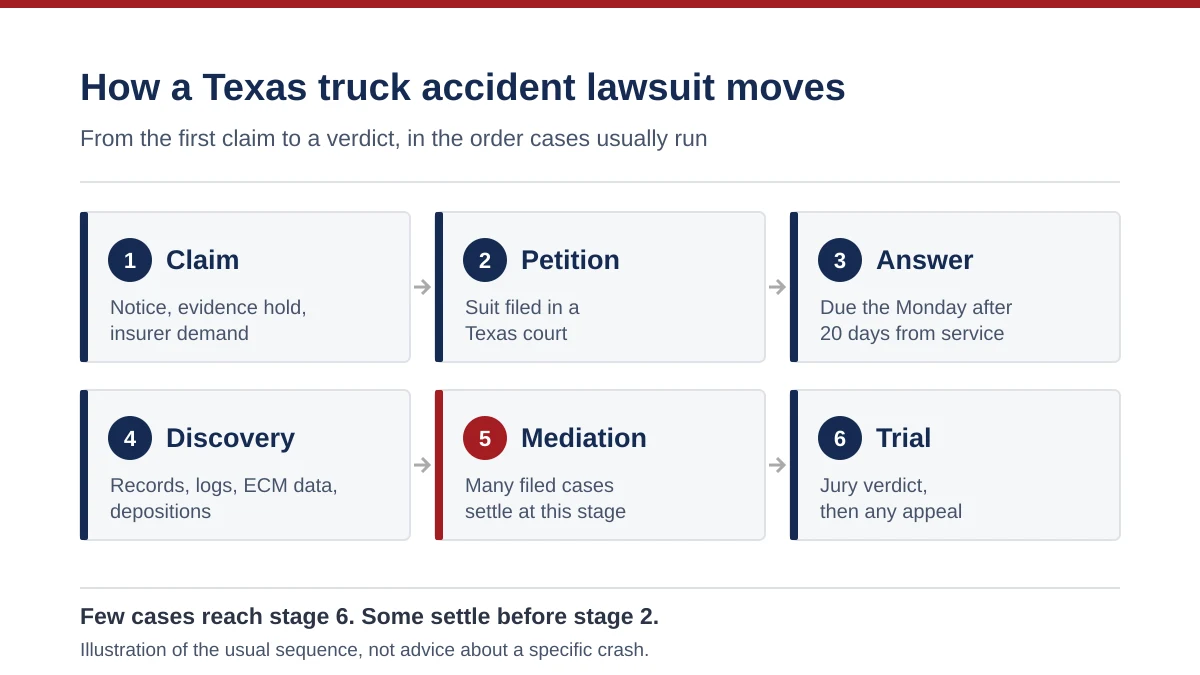
Quick answer: A truck accident lawsuit in Texas usually moves through six stages: the insurance claim, the petition, the trucking company's answer, discovery, mediation, and trial. Most cases settle before a jury hears them. You generally have two years from the crash to file suit, but the evidence that proves a truck case can disappear in months, so the work starts long before the filing deadline.
Truck accidents are different from a typical car accident claim. After a wreck with an 18-wheeler, the defendant is usually a motor carrier with its own lawyers, a main insurance policy, and sometimes excess coverage stacked on top. The records that prove fault belong to the carrier. Filing suit is how you force those records into the open.
This guide walks through each stage the way cases actually run in Texas courts. It explains what you do, what the carrier does, and where cases tend to settle.
Truck Accident Claim vs. Lawsuit: What Changes When You File
Most truck accident cases start as a claim. Your lawyer notifies the carrier and its insurer, collects the police report and medical records, and sends a demand. The insurer can pay, negotiate, or deny. Nothing about a claim forces the carrier to show you its own files.
Filing suit changes that. Once a case is on file, Texas rules require each side to disclose its insurance agreements, its witnesses, and the documents it plans to use. The other side can then demand more through written discovery and depositions taken under oath.
Signs a claim may need to go to court
- The insurer disputes who caused the wreck or blames you for it.
- The offer does not cover your medical care, lost income, or future treatment.
- The carrier will not confirm its policy limits or whether excess coverage exists.
- Several businesses point at each other: carrier, broker, shipper, or a maintenance shop.
- The wreck was fatal, and a family needs a wrongful death claim on file.
- The two-year deadline is getting close and the claim has not resolved.
Filing suit often makes an insurer take a claim seriously for the first time, because the carrier now faces discovery costs and a trial date. Many truck cases settle after filing and before trial.
The Six Steps of Suing a Trucking Company in Texas
Let's break it down. Every case has its own facts, but the order below holds for most truck accidents litigated in Texas state court.
Step 1: The claim, the evidence hold, and the demand
The first weeks after the wreck decide what evidence will exist later. Federal rules require carriers to keep a driver's hours-of-service records for at least six months under 49 CFR 395.8(k). The truck's engine control module can be overwritten once the rig goes back into service. Dash camera footage can be recorded over even sooner.
That is why a preservation demand, often called a spoliation letter, goes out first. It tells the carrier to keep the truck, the logs, the dispatch messages, and the video. Under Texas law, the duty to preserve evidence starts once a party knows or should know a claim is likely, and a preservation letter removes any doubt about that. If the carrier destroys evidence after that point, a Texas court can sanction it. In serious cases, such as intentional destruction, the court can tell the jury about it.
While the evidence is locked down, you get medical treatment. Your lawyer gathers the police report, photos, witness information, and the carrier's safety history. When your condition is stable enough to value the claim, a demand goes to the insurer.
Step 2: Filing the petition
A Texas case starts with a document called an original petition. It names the defendants, describes the collision, states the legal claims, and asks for damages. Under Texas Rule of Civil Procedure 47, the petition must also state which range of relief you seek. After an October 2026 order from the Supreme Court of Texas, the lowest range now tops out at $325,000, and the middle range runs from there to $1,000,000. Serious truck cases usually plead the top range.
Where the case is filed
The general venue rule in Civil Practice and Remedies Code Section 15.002 allows filing in the county where all or a major part of the events behind the claim occurred, or in the county of a defendant's principal Texas office. If a carrier's principal Texas office is in Harris County, that can put the case in Houston even when the wreck happened on I-20 near Midland. Venue choices affect the jury pool, the speed of the docket, and the local rules.
Who gets named
The petition usually names the motor carrier and the driver. Depending on the facts, it can also name the trailer owner, a leasing company, a shipper or loader, a broker, or a parts manufacturer. Our guide to suing the trucking company in Texas covers how each one can answer for the injury it caused.
State court or federal court
Many trucking companies are based outside Texas. When every plaintiff is a citizen of a different state than every defendant and more than $75,000 is at stake, an out-of-state carrier can usually move the case to federal court under 28 U.S.C. 1441 and 28 U.S.C. 1332. A company counts as a citizen of the state where it is incorporated and the state where its headquarters sits. Naming a Texas citizen as a defendant, such as a driver who lives here, usually keeps a Texas plaintiff's case in state court. Carriers sometimes try to remove before that Texas defendant is served, so prompt service matters. Federal court brings different rules, a different jury pool, and often a tighter schedule.
Step 3: Service and the carrier's answer
After filing, each defendant must be formally served. Texas Rule 99 gives a defendant until 10:00 a.m. on the Monday after 20 days from service to file an answer. Most carriers file a general denial, which puts every fact in dispute until it is proven. Defendants also raise affirmative defenses, such as claiming you share the blame.
Shared fault matters in Texas. Under Chapter 33, your recovery drops by your percentage of responsibility, and it is barred entirely if you are found more than 50 percent at fault. Our article on comparative negligence in Texas shows how that math works.
Step 4: Discovery
Discovery is usually the longest stage, and it produces most of the evidence a jury would see. Within 30 days after a defendant answers, both sides must make initial disclosures under Texas Rule 194. Those disclosures include any insurance and indemnity agreements, persons with knowledge, and the documents each side may use. For the first time, you learn how much coverage actually stands behind the carrier.
Written discovery
Your lawyer then requests the carrier's records. In a commercial truck case, that list usually includes:
- The driver qualification file, including the driving record and prior employer checks
- Electronic logging device data and hours-of-service records
- Engine control module downloads showing speed, braking, and throttle
- Dispatch messages, delivery schedules, and trip paperwork
- Inspection, maintenance, and repair records for the tractor and trailer
- Dash camera and forward-facing camera video
- Drug and alcohol testing results after the collision
- The carrier's safety policies and its internal accident review
Our guides to truck black box data and FMCSA regulations in a Texas truck case explain what those records can prove.
Depositions
A deposition is sworn testimony taken outside the courtroom with a court reporter present. In a truck case, the important ones are the driver, the carrier's safety director or dispatcher, and a corporate representative who must speak for the company as a whole. The defense lawyers will also depose you about the wreck, your injury, and your life before and after.
Experts
Most serious truck cases need experts. An accident reconstructionist can use engine data and scene evidence to show speed and timing. A motor carrier safety expert can explain which federal rules the carrier broke. Doctors, life care planners, and economists explain the cost of your injuries over time.
The Chapter 72 split trial
Texas has special rules for commercial vehicle cases in Chapter 72 of the Civil Practice and Remedies Code. On a defendant's motion, the court must split the trial into two phases. The first phase decides fault and compensatory damages. The second decides punitive damages and some claims against the employer. If the employer stipulates in time that the driver was its employee acting on the job, its liability for the driver's ordinary negligence rests on that relationship alone, and some evidence about its hiring practices waits for the second phase. Section 72.055 also lets photos and video come in without an expert just to vouch for them. These rules shape discovery from day one, so your lawyer plans for them early.
Step 5: Mediation and settlement talks
Most Texas courts send civil cases to mediation before trial under Chapter 154. A mediator is a neutral person, often a retired judge or a veteran trial lawyer, who meets with both sides and carries offers back and forth. Mediation is confidential. Nobody can force you to accept an offer there.
By mediation, both sides have seen the evidence. They know the strengths and weak spots of the claim, the insurance available, and the likely range of verdicts in that county. That is why many truck accident settlements happen at this stage. A claim that does not settle at mediation can still settle on the courthouse steps.
Texas also has a formal offer process in Chapter 42. Once a defendant opts in, either side can make a written settlement offer. If the other side rejects it and the judgment falls far enough on the wrong side of it (below 80 percent of a defendant's offer, or above 120 percent of a claimant's offer), the court must shift some litigation costs. Your lawyer should explain any Chapter 42 offer before you decide.
Step 6: Trial and appeal
If the case does not settle, a jury decides it. In Texas district court, a jury has 12 members, and the same 10 or more jurors must agree on every answer in the verdict. Punitive damages require a unanimous jury. A truck trial can last from several days to a few weeks, depending on the number of parties and experts.
After a verdict, the losing side can ask for a new trial and then appeal. Texas appellate rules generally give 30 days after judgment to file a notice of appeal, with more time if a post-trial motion is filed. An appeal can add a year or more before money changes hands. That risk is one reason some cases settle even after a verdict.
The Compensation a Texas Truck Case Can Recover
A Texas truck case seeks compensation for what the wreck took from you, and a jury can award compensation only in the categories Texas law allows. Our guide to the average truck accident settlement in Texas explains why no honest statewide average exists.
Economic damages
- Past medical bills, limited by Section 41.0105 to amounts actually paid or incurred, and the reasonable cost of future care
- Lost wages and lost earning capacity if you cannot return to the same work
- Property damage and the cost of a replacement vehicle
- Home care, modifications, and other costs tied to a lasting injury
Non-economic damages
These cover physical pain, mental anguish, physical impairment, and disfigurement, both past and future. Texas does not cap non-economic damages against a private carrier the way it does in medical malpractice cases. Claims against a government vehicle have their own caps, covered below.
Punitive damages
When a carrier acts with gross negligence or malice, a jury can award punitive damages to punish the conduct. Texas caps them under Section 41.008, with exceptions for certain crimes such as intoxication assault and intoxication manslaughter. The claimant must prove punitive damages by clear and convincing evidence. Examples that can support the claim include knowingly keeping an unqualified driver on the road or pressuring drivers to break hours-of-service limits.
Wrongful death claims
In fatal truck accidents, the Texas Wrongful Death Act lets the surviving spouse, children, and parents sue for their own losses, such as lost support, lost companionship, and mental anguish. A separate survival claim belongs to the estate and covers what the person who died suffered before death. A wrongful death claim and a survival claim often run in the same suit. Our wrongful death page explains how those claims work for a family.
Interest on the judgment
In personal injury and wrongful death cases, prejudgment interest generally begins on the earlier of the 180th day after the defendant receives written notice of the claim or the day suit is filed, under Finance Code Chapter 304. It does not apply to future damages. Because notice can start the clock, a written claim sent early can add interest to a later judgment.
How Long a Semi Truck Accident Lawsuit Takes, and the Deadlines
Here is why timing matters so much. Every semi truck accident lawsuit runs on two clocks: the legal deadline to file and the practical deadline before evidence disappears.
The two-year filing deadline
Under Section 16.003, you generally have two years from the date of the collision to file a personal injury suit, and two years from the date of death for a wrongful death case. Negotiating with an insurer does not pause that deadline. Miss it, and the claim is usually gone no matter how strong it was. Our page on the Texas truck accident statute of limitations covers the exceptions.
Government trucks
If a city, county, or state vehicle caused the wreck, the Texas Tort Claims Act requires notice within six months, and many city charters require it far sooner. Give that notice in writing to be safe. The Act excuses formal notice only when the government already has actual notice of the injury or death. It also caps damages: $250,000 per person and $500,000 per occurrence against the state or a city, and lower limits for other local units. Punitive damages are not available against them. Garbage trucks, city dump trucks, and maintenance vehicles fall in this group.
How long the whole case takes
No one can promise a timeline. A clear liability claim with finished treatment can resolve in months, sometimes without suit. An 18 wheeler accident lawsuit with contested fault, catastrophic injuries, and several defendants can take a few years to reach trial. Our guide on how long a Texas truck accident settlement takes walks through what speeds a claim up and what slows it down.
- Cases move faster when fault is clear and the evidence was preserved early.
- Cases slow down when treatment is ongoing, coverage is disputed, or a defendant removes the suit to federal court.
- Court dockets vary by county, so where you file affects the schedule.
Common Questions About Suing After Truck Accidents
Do most truck accident lawsuits go to trial?
No. Most truck cases resolve through a settlement, either before suit is filed, during discovery, or at mediation. Filing suit often moves the carrier's insurer, because discovery forces the carrier to produce driver files, logs, and engine data it would not hand over voluntarily. The ability to try the case is what gives a settlement offer its weight.
How long does a truck accident lawsuit take in Texas?
There is no fixed timeline. A claim with clear liability and finished medical treatment can resolve within months, sometimes without suit at all. A contested claim with serious injuries, several defendants, and layered insurance can take a year or longer once suit is filed. Court dockets, the number of depositions, and a move to federal court all affect the pace.
What is the difference between a truck accident claim and a lawsuit?
A claim is a demand made to the carrier's insurer outside of court. A lawsuit is filed in a Texas or federal court against the people and businesses responsible. Many truck accidents start as claims and end up in court when the insurer disputes fault, offers too little, or the two-year filing deadline gets close.
Who do you sue in a semi truck accident lawsuit?
Usually the motor carrier, and often the driver as well. Depending on the facts, the petition can also name the owner of the trailer, a leasing company, the shipper or loader of the cargo, a maintenance contractor, a freight broker, or a parts manufacturer. Each defendant can bring its own insurance policy to the table.
Can a trucking company move my case to federal court?
Sometimes. If every defendant is a citizen of a different state than every plaintiff and the amount in controversy is more than $75,000, the carrier can usually remove a Texas state court case to federal court. Properly naming and serving a Texas citizen as a defendant, such as a driver who lives in Texas, generally blocks removal on that basis. Carriers sometimes try to remove before the Texas defendant is served, so prompt service matters.
How much does it cost to sue a trucking company?
With a contingency fee lawyer, you pay nothing up front. The firm advances filing fees, deposition costs, and expert fees, and it is paid only if there is a recovery. Our firm's fee terms are laid out in our guide to what a truck accident lawyer costs in Texas.
Talk With Us About Your Texas Truck Crash
You do not need to decide today whether to file suit. You need to know where your claim stands and what evidence has to be saved now. Tell us what happened, and we will explain which stage you are in and what comes next. The review is free, and you owe no attorney's fee unless we recover for you.
Call or text (832) 250-4888 any time, or request a free case review. You can also read about what a truck accident lawyer costs in Texas before you call.
This article is general information about Texas law and procedure. It is not legal advice, and reading it does not create an attorney-client relationship. Deadlines, venue, and the claims available depend on the facts of each wreck. Texas rules of procedure are published by the Texas Judicial Branch.

No fee unless we win.
Past results do not guarantee a similar outcome.
“Texas Truck Accident Lawyer was a huge help after an 18-wheeler rear ended me. They explained every step clearly and made sure I understood my options. The entire team was supportive and easy to work with.”
“The team at Texas truck accident lawyer was very respectful and impressive, they listened to my issue without making me feel like a burden”