
A bobtail truck is a truck tractor traveling without a trailer attached. It is the cab and tractor chassis on their own, rather than the tractor pulling a semitrailer. Bobtailing describes that configuration. It does not tell you why the truck was on the road or who is responsible for a crash.
The missing trailer matters, but not in the way many people expect. Less weight does not prove a shorter stop. The California Commercial Driver Handbook, section 6.1.3, warns that bobtail tractors can be hard to stop smoothly. That is a reason to examine the truck and the conditions, not to assume that every bobtail crash happened for the same reason.
Bobtail vs. deadhead: what is the difference?
Start with two separate questions: Is there a trailer? Is there cargo? They are not the same question.
The commercial driver handbook describes bobtail tractors as tractors without semitrailers. The Federal Highway Administration's freight glossary describes deadhead as the return of an empty transportation container, commonly an empty backhaul. In the comparison below, the deadhead example is a tractor pulling an empty trailer.
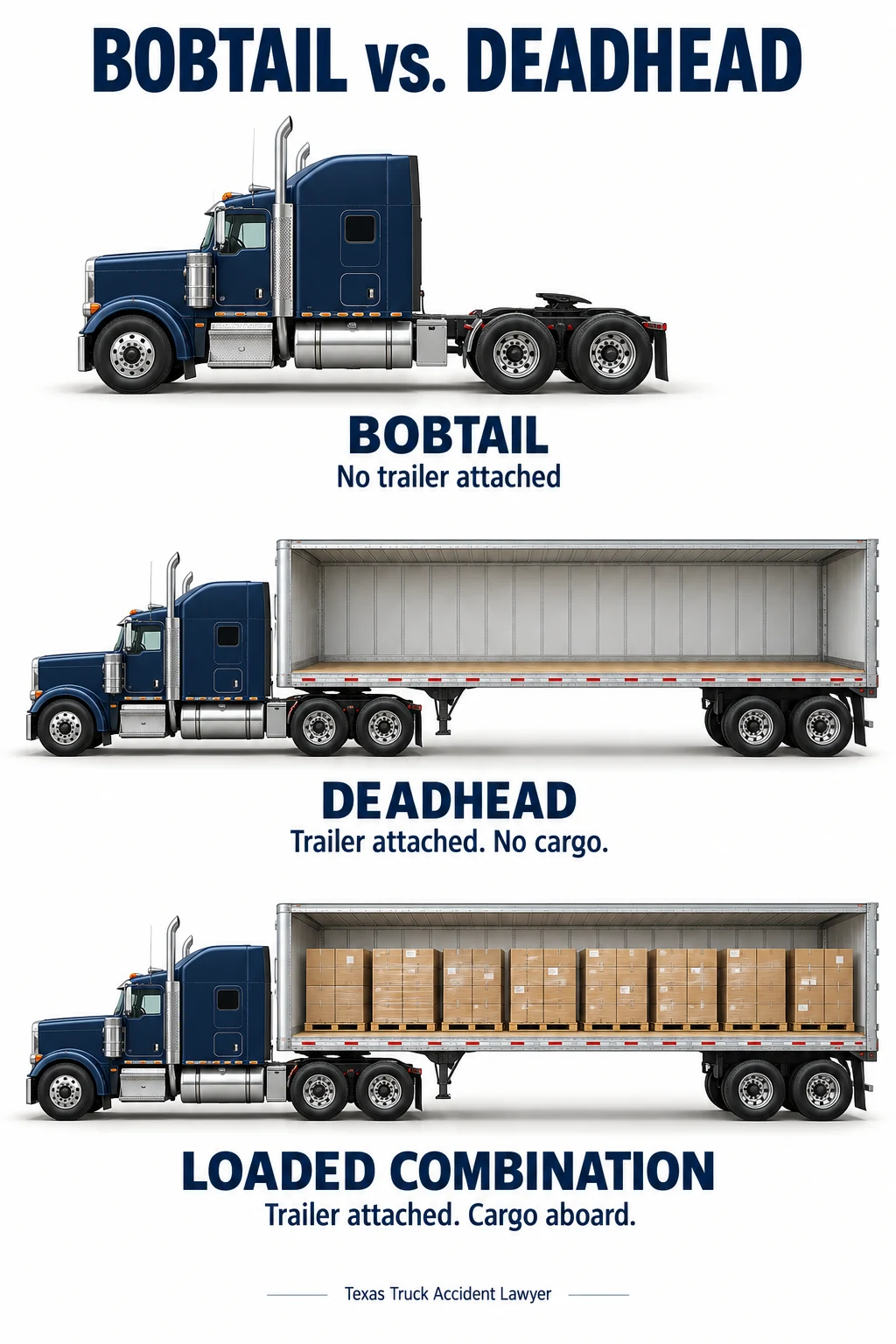
| Configuration | Trailer | Cargo in trailer |
|---|---|---|
| Bobtail tractor | Not attached | No trailer |
| Deadhead example | Attached | Empty |
| Loaded combination | Attached | Present |
Do not use the word “empty” alone to describe the truck involved in a collision. An empty trailer and no trailer are different configurations. A photo showing what was actually attached is more useful than a witness's choice of trucking term.
Why can bobtailing make braking harder?
It is tempting to think a lighter truck must stop faster. Commercial driver training warns against that shortcut.
Section 6.1.3 of the California handbook says that bobtail tractors can be hard to stop smoothly and compares their stopping distance with that of a tractor and semitrailer loaded to maximum gross weight. The handbook's separate discussion of empty trucks in section 2.6.1 explains that less traction can mean a greater stopping distance.
That does not supply a stopping distance for the truck in your crash. It is training guidance, not a test of a particular tractor on a particular road. It also does not mean that every bobtail tractor stops worse than every loaded truck under every set of conditions.
A useful investigation asks about the road surface, tires, brakes, speed and the driver's actions before impact. Our guide to semi truck stopping distance explains why a single distance cannot answer all of those questions.
The brakes are not simply “at the rear”
A claim that a bobtail tractor relies only on its rear wheels for braking leaves out the federal equipment rule. 49 CFR §393.42 generally requires brakes acting on all wheels of commercial motor vehicles covered by the rule, subject to its listed exceptions. One exception concerns certain older trucks and tractors manufactured before July 25, 1980.
The rule tells you what equipment is required within its scope. It does not prove that a particular truck's brakes were working, that its tires had enough grip or that the driver responded in time. Those are separate questions for the evidence.
Do not turn a warning into a crash conclusion
The fact that a truck had no trailer does not, by itself, explain a collision. Ask what happened: Did the tractor skid? Did it cross into another lane? Was the driver following too closely? Was there a brake or tire problem? A reconstruction should address the observed events rather than begin with “bobtail trucks are dangerous” as its answer.
This guide does not give a bobtail crash rate, a universal stopping distance or a claim that bobtails are always more dangerous than loaded trucks. The cited handbook warning does not establish those conclusions.
What matters after a bobtail truck accident in Texas?
For an injured person, the immediate issue is not which trucking label fits. It is what happened, whose conduct contributed and what records can help answer those questions.
Separate the condition of the truck from the purpose of the trip. A photo can establish whether a trailer was attached. It cannot show the entire dispatch history, lease agreement or insurance policy.
Find out what the driver was doing
Do not assume a trip was personal because the tractor had no trailer. Ask where the driver had come from, where the driver was going and who had given any instructions. Was there a planned pickup? Had a delivery just ended? Was the tractor going for service? Treat those as questions for records and witnesses, not facts to assume.
Ask for the dispatch messages, trip paperwork and any available location records that address the trip. Compare them with the driver's account. If the tractor was leased, ask for the agreement as well. These are records to investigate, not a promise that every case will contain the same documents.
Read the insurance wording, not just the label
“Bobtail insurance” and “nontrucking liability” are terms you may encounter during a claim. Do not assume that those labels mean the same thing in every policy, or that the absence of a trailer automatically brings a crash within coverage.
A coverage review should identify the actual policy and endorsements, the named insureds, the vehicle and the facts of the trip. Ask which insurer is accepting or disputing coverage and what policy language it relies on. A claim decision needs that information, not a guess based on the tractor's appearance.
Keep questions about liability separate from questions about insurance. Do not treat a company name on the door as a complete answer to either one.
What if someone says you share fault?
For cases governed by Texas Civil Practice and Remedies Code Chapter 33, section 33.001 bars recovery when the claimant's percentage of responsibility is greater than 50 percent. If the claimant is not barred, section 33.012(a) reduces damages by the claimant's assigned percentage of responsibility.
That rule does not assign a percentage simply because a tractor was bobtailing. Nor does it make an insurer's accusation the final answer. Preserve the evidence of what each vehicle did rather than accept a fault percentage without asking how it was reached.
What evidence should you preserve?
Put medical care and immediate safety first. Do not step into traffic, approach an unsafe vehicle or delay needed care to collect evidence.
If it is safe, save photos that show the tractor, whether a trailer was attached, the vehicles' positions and visible company markings. Keep the crash report information and any video or witness contact details you already have. Do not alter the original files.
When speaking with a lawyer, ask about preserving these records and arranging any needed inspection:
- The tractor and its condition. Ask about inspecting the brakes and tires before repairs change what can be examined.
- The trip. Ask about dispatch instructions, pickup or delivery paperwork and available location records.
- Ownership and agreements. Ask who owned the tractor and what any lease says.
- Policies and coverage correspondence. Ask for the actual insurance documents rather than relying on a verbal description.
- Electronic records and video. Ask what the vehicle or its systems actually recorded. Do not assume every truck has the same data.
Our guides to truck electronic evidence and preservation requests after a truck crash explain questions to raise during that review. This article does not promise that a particular field, camera recording or document exists in your case.
Common questions about bobtail trucks
What does bobtail mean in trucking?
A bobtail tractor is a truck tractor traveling without its semitrailer. That describes the equipment attached to the tractor. It does not tell you whether the trip was for work or personal use.
Is bobtailing the same as deadheading?
Not in the comparison used here. The bobtail tractor has no trailer attached. The deadhead example has an attached trailer with no cargo. The Federal Highway Administration describes deadhead as the return of an empty transportation container, commonly an empty backhaul.
Do bobtail trucks stop faster because they weigh less?
You cannot decide that from weight alone. California's commercial driver handbook warns that bobtail tractors can be hard to stop smoothly. Its comparison with a fully loaded combination is driver training guidance, not a stopping distance prediction for every truck or crash.
Does bobtail insurance automatically cover a crash without a trailer?
Do not assume coverage from that label. A claim review should examine the actual policy, any endorsements, the purpose of the trip and the people or businesses insured. The absence of a trailer is not a substitute for that review.
What should I document after a bobtail truck accident?
After attending to injuries and immediate safety, save the crash report information and any photos, video or witness details you can obtain safely. Note whether a trailer was attached and photograph the tractor's company markings if you can do so without entering traffic. Ask a lawyer about preserving the trip records and inspecting the tractor.
Talk with us about your Texas truck crash
You do not need to identify the correct insurance policy before asking for help. If you were injured in a crash involving a tractor without a trailer, tell us what happened and what information you have. We can discuss your situation and the questions that need answers.
Request a free case review from Texas Truck Accident Lawyer.
This article provides legal information, not advice about a particular claim. Responsibility and insurance coverage require a review of the facts and applicable law.
Sources
California DMV, Commercial Driver Handbook, sections 2.6.1 and 6.1.3. Driver training guidance on traction, stopping and bobtail tractors.
Federal Highway Administration, Freight Glossary, “Deadhead.” Terminology for an empty return or backhaul.
49 CFR §393.42, 2025 annual edition. Federal brake equipment requirements and listed exceptions.
Texas Civil Practice and Remedies Code §33.001 and §33.012. Proportionate responsibility and reduction of damages.

No fee unless we win.
Past results do not guarantee a similar outcome.