
A jake brake is an engine brake on a diesel truck. When the driver lifts off the accelerator, it shuts off the fuel and opens the exhaust valves at the top of each compression stroke. The engine stops making power and starts absorbing it, which slows the truck without using the wheel brakes. The proper name is a compression release engine brake.
"Jake" is short for Jacobs, the company that put the first one on the market in 1961. The loud popping you hear from a truck coming down a hill is this device at work. It is loudest on a truck with a poor muffler or none.
How does a jake brake work?
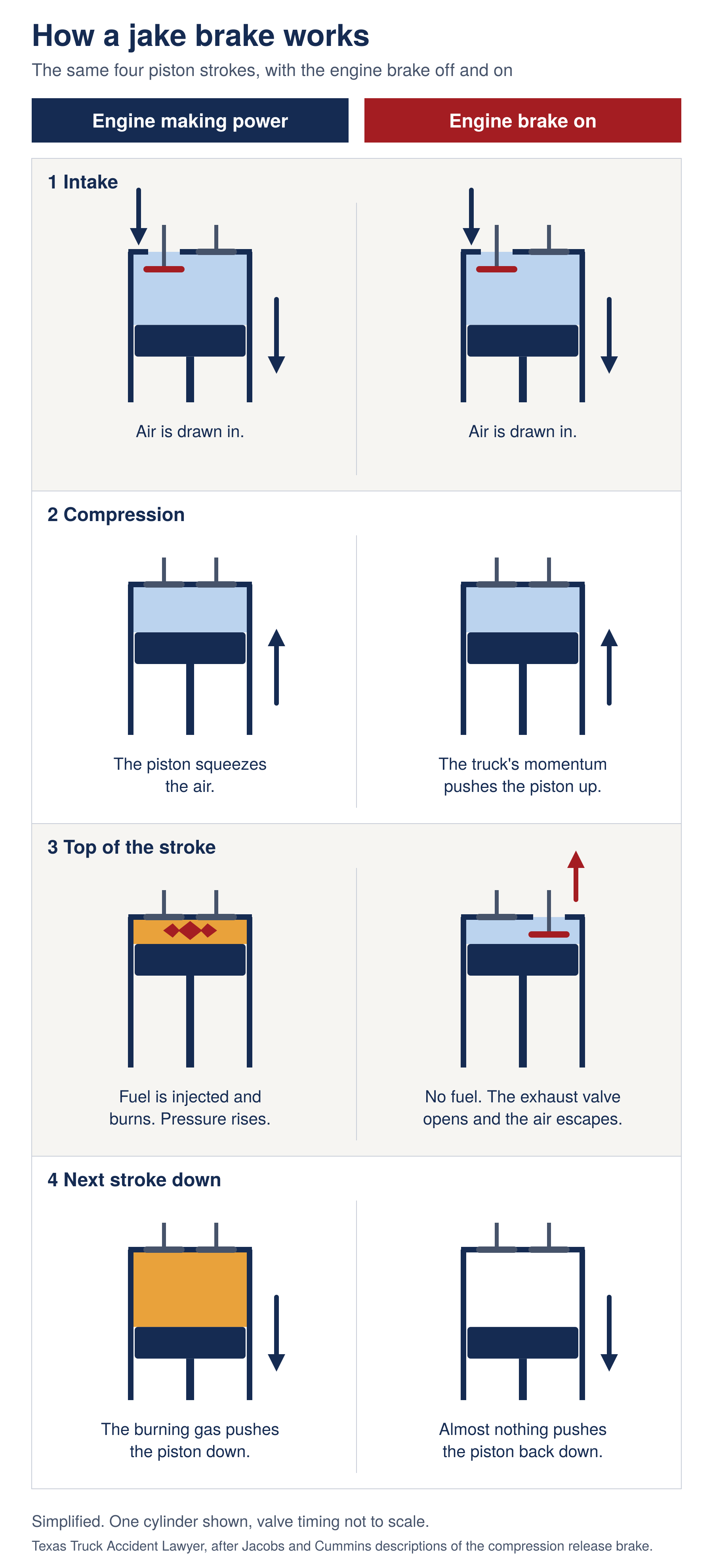
A diesel engine makes power by squeezing air in a cylinder, injecting fuel, and letting the burning gas push the piston back down. A jake brake keeps the squeeze and throws away the push.
Cummins, which now owns the Jacobs brand, describes the sequence this way. With the engine brake on and no fuel going in:
- The truck's momentum keeps turning the engine, and each piston compresses a cylinder full of air.
- Near the top of the compression stroke, the engine brake opens the exhaust valves.
- The compressed air rushes out through the exhaust system.
- Little of the energy that went into compressing the air comes back to the piston, and the cycle repeats.
Cummins sums it up as turning a power-producing engine into a power-absorbing air compressor. The energy that would have kept the truck rolling leaves through the exhaust.
The driver can turn it on or off. The Texas Commercial Motor Vehicle Drivers Handbook (section 2.3.4) explains that a retarder that is switched on applies its braking power whenever the driver lets up on the accelerator all the way, and that it acts on the drive wheels only.
Why do trucks use engine brakes?
The reason is heat. A loaded tractor-trailer coming down a long grade asks its wheel brakes to shed a great deal of energy, and they shed it as heat.
The Texas handbook (section 2.16) warns that brakes used too hard on a downgrade can fade, which means the driver has to press harder and harder for the same stopping power, until the brakes may not slow the truck at all. It tells drivers to use the braking effect of the engine as the main way of controlling speed on a downgrade and to treat the wheel brakes as a supplement.
An engine brake adds to that engine braking effect. The wheel brakes stay cooler and are still there when the driver needs a hard stop. Cummins lists preventing brake fade and reducing brake wear among the benefits.
Why is it called a jake brake?
The inventor was Clessie Cummins, who founded the Cummins engine company.
The Jacobs Manufacturing Company brought the first engine brake for commercial vehicles to market in 1961, according to a Cummins press release filed with the SEC. The patent, U.S. Patent 3,220,392, was filed in June 1962 and issued on November 30, 1965. Truckers shortened "Jacobs brake" to "jake brake," and the nickname spread to engine brakes from every maker.
In February 2022 Cummins Inc. announced it would buy Jacobs Vehicle Systems, which by then had produced more than nine million engine brakes. Jake Brake is still a Jacobs trademark. The company's brochure for communities asks sign makers to write "engine brake" instead.
Why are jake brakes so loud?
Each time an exhaust valve opens, a charge of highly compressed air bursts into the exhaust. An engine has several cylinders doing this in turn, many times a second. Jacobs describes the result as a staccato sound.
How loud it gets depends mostly on the muffler. In a paper titled Vehicle Noise Levels and Compression Release Engine Braking, Jacobs reports two findings from industry studies:
- A properly muffled truck with its engine brake on is about as loud as the same truck accelerating.
- Trucks with "straight stacks," meaning no muffler, are 16 to 22 dB(A) louder than trucks with original equipment mufflers.
Keep in mind that Jacobs sells engine brakes, and that the paper dates from 2000. Federal and Texas law both require a working muffler, as the next sections show.
Federal noise rules cover trucks with or without an engine brake:
- New trucks. EPA's standard for new medium and heavy trucks has been 80 dBA for trucks built after January 1, 1988, down from 83 dBA starting in 1979 (40 CFR 205.52).
- Trucks on the road. For trucks over 10,000 pounds run by interstate motor carriers, 40 CFR 202.20 sets limits measured 50 feet from the center of the lane. For 1986 and later model years the limit is 83 dB(A) where the speed limit is 35 mph or less and 87 dB(A) on faster roads. The rule applies under any condition of grade, load, acceleration or deceleration.
- Mufflers. The same part bars a carrier from running a truck without a muffler or with a cutout or bypass (40 CFR 202.22).
Jake brake vs. exhaust brake vs. retarder
"Retarder" is the broad term for any device that slows a truck without the wheel brakes. The Texas handbook names four types. A jake brake is the engine type.
| Type | How it slows the truck |
|---|---|
| Engine brake (jake brake) | Opens the exhaust valves near the top of the compression stroke and releases the compressed air. |
| Exhaust brake | Restricts the exhaust so the engine works against back pressure. |
| Hydraulic retarder | Uses fluid to resist the turning driveline. |
| Electric retarder | Uses electromagnets to resist the turning driveline. |
All four share two traits the handbook points out: the driver can switch them on and off, and they act on the drive wheels only.
Is jake braking illegal in Texas?
It depends on the town. In Texas the restrictions on engine braking are local.
- City ordinances. A number of Texas cities and towns prohibit or limit engine braking inside their limits. The Town of Anderson's ordinance, passed in February 2026, makes engine braking inside the town limits a misdemeanor with a fine of up to $500. It exempts emergency vehicles and gives a driver a defense if the brake was used in an emergency. Penalties and exceptions differ from place to place, so read the ordinance for the town in question.
- The sign. TxDOT's sign book has a standard design for these places. Sign R5-4aT reads NO ENGINE BRAKE BY LOCAL ORDINANCE.
- State muffler law. Texas Transportation Code section 547.604 requires a motor vehicle to have a muffler in good working condition that continually operates to prevent excessive or unusual noise. It also prohibits a muffler cutout, bypass or similar device.
These ordinances are aimed at noise.
When is a jake brake dangerous?
On a slick road. An engine brake slows only the drive wheels, the ones at the back of the tractor. If those wheels have poor traction, the braking force can make them skid.
The Texas handbook says it plainly under a caution heading: turn the retarder off whenever the road is wet, icy or snow covered. Its section on skids (2.19) explains what follows a drive-wheel skid on a truck pulling a trailer. The trailer can push the tractor sideways and cause a sudden jackknife.
The Federal Motor Carrier Safety Administration gives the same warning. It says manufacturers advise against using a retarder on wet or slippery roads, and it points to a December 1999 motor coach crash on a snow-covered mountain road near Canon City, Colorado, where a Safety Board investigation found that an enabled retarder most likely triggered the loss of control.
The opposite mistake is just as serious. A driver who rides the wheel brakes down a long grade without enough engine braking can overheat them. That is the brake fade the handbook warns about, and it is how a truck becomes a runaway.
What does a jake brake mean after a truck crash?
Usually it is one question among many. In two kinds of crash it deserves a closer look:
- A jackknife or loss of control on a wet or icy road. Was the engine brake switched on? The handbook tells drivers to turn it off in those conditions.
- A runaway or brake failure on a downgrade. What gear was the truck in, was the engine brake working, and were the wheel brakes in adjustment? The handbook says brakes that are out of adjustment leave the others to overheat and fade.
A Texas crash report will not answer those questions. The CR-3 has no box for engine brake use. It does record related facts in code: the road surface, any brake defect the officer noted, and events such as a jackknife or a downhill runaway. Our Texas crash report code decoder lists every one.
The rest comes from the driver, the truck and the company's records. See our guides to jackknife truck accidents, truck electronic data and how long a trucking company must keep its records. We do not assume a particular truck recorded any particular fact until someone has checked.
Common questions about jake brakes
What is a jake brake?
A jake brake is a compression release engine brake on a diesel truck. With the driver's foot off the accelerator, it cuts fuel and opens the exhaust valves near the top of each compression stroke, so the engine absorbs the truck's momentum instead of producing power. The name comes from Jacobs, the company that first built it in 1961.
Why are jake brakes so loud?
The sound is compressed air leaving the cylinders in quick pulses when the exhaust valves open. Jacobs, the manufacturer, says a truck with a proper muffler is about as loud with the engine brake on as it is when accelerating, and that trucks with no muffler are 16 to 22 decibels louder than trucks with factory mufflers.
Is jake braking illegal in Texas?
It depends on where you are. A number of Texas cities and towns prohibit or limit engine braking by local ordinance, and TxDOT has a standard sign for those places that reads NO ENGINE BRAKE BY LOCAL ORDINANCE. Statewide, Transportation Code section 547.604 requires every motor vehicle to have a working muffler and bans muffler cutouts and bypasses.
What is the difference between a jake brake and an exhaust brake?
A jake brake changes when the exhaust valves open, releasing the air the engine has compressed. An exhaust brake leaves the valves alone and restricts the exhaust pipe so the engine works against back pressure. Both are retarders. The Texas commercial driver handbook lists four types: exhaust, engine, hydraulic and electric.
When should a truck driver turn the jake brake off?
On slick roads. The Texas commercial driver handbook tells drivers to turn the retarder off whenever the road is wet, icy or snow covered, because it can make the drive wheels skid. The Federal Motor Carrier Safety Administration says manufacturers give the same advice.
Does a jake brake replace the regular brakes?
No. The Texas commercial driver handbook describes retarders as devices that help slow a vehicle and reduce the need for the brakes. On a long downgrade the engine does most of the work of holding speed, and the wheel brakes stay cooler for the times the driver needs them.
Hurt in a crash with a commercial truck in Texas?
Tell us what happened. We can talk through what the report says and what should be preserved before it is lost.
Request a free case review from Texas Truck Accident Lawyer, or call or text (832) 250-4888.
This article provides general information, not legal advice about a particular claim. City ordinances change. Check the current ordinance for any town you are asking about.
Sources
Cummins, Compression Release Engine Brake. How the Jacobs engine brake works and what it is for.
Cummins Inc., press release of February 9, 2022, filed with the SEC. The 1961 introduction, the inventor, the nine million figure and the acquisition.
U.S. Patent 3,220,392, C. L. Cummins, Vehicle engine braking and fuel control system, issued November 30, 1965.
Jacobs Vehicle Systems, Vehicle Noise Levels and Compression Release Engine Braking, rev. 1/00, and the Jacobs noise brochure. Copies filed with the Vermont Legislature.
40 CFR Part 202 and 40 CFR 205.52. Federal truck noise limits and the muffler requirement.
Texas Department of Public Safety, Texas Commercial Motor Vehicle Drivers Handbook (DL-7C), revised March 2026, sections 2.3.4, 2.16 and 2.19.
FMCSA, CMV Driving Tips: Too Fast for Conditions. Retarder use on slippery roads.
Texas Transportation Code §547.604. Muffler required.
TxDOT, Standard Highway Sign Designs for Texas, 2026 edition, sign R5-4aT.

 Army Green Beret
Find out for free. Ethan from Sgt. Pike's team calls you within 5 minutes.
Past results do not guarantee a similar outcome.
“Texas Truck Accident Lawyer was a huge help after an 18-wheeler rear ended me. They explained every step clearly and made sure I understood my options. The entire team was supportive and easy to work with.”
“The team at Texas truck accident lawyer was very respectful and impressive, they listened to my issue without making me feel like a burden”