
Trucks make wide turns because a trailer's rear wheels cut inside the cab's path. Through a slow turn, the rear wheels pass closer to the corner. The cab needs enough room for the trailer to clear it.
At Texas Truck Accident Lawyer, we examine both paths after a turning crash. Needing extra room does not automatically excuse an unsafe turn, and being beside a truck does not automatically make the crash your fault. We look at each vehicle's movements and the available evidence.
The diagram
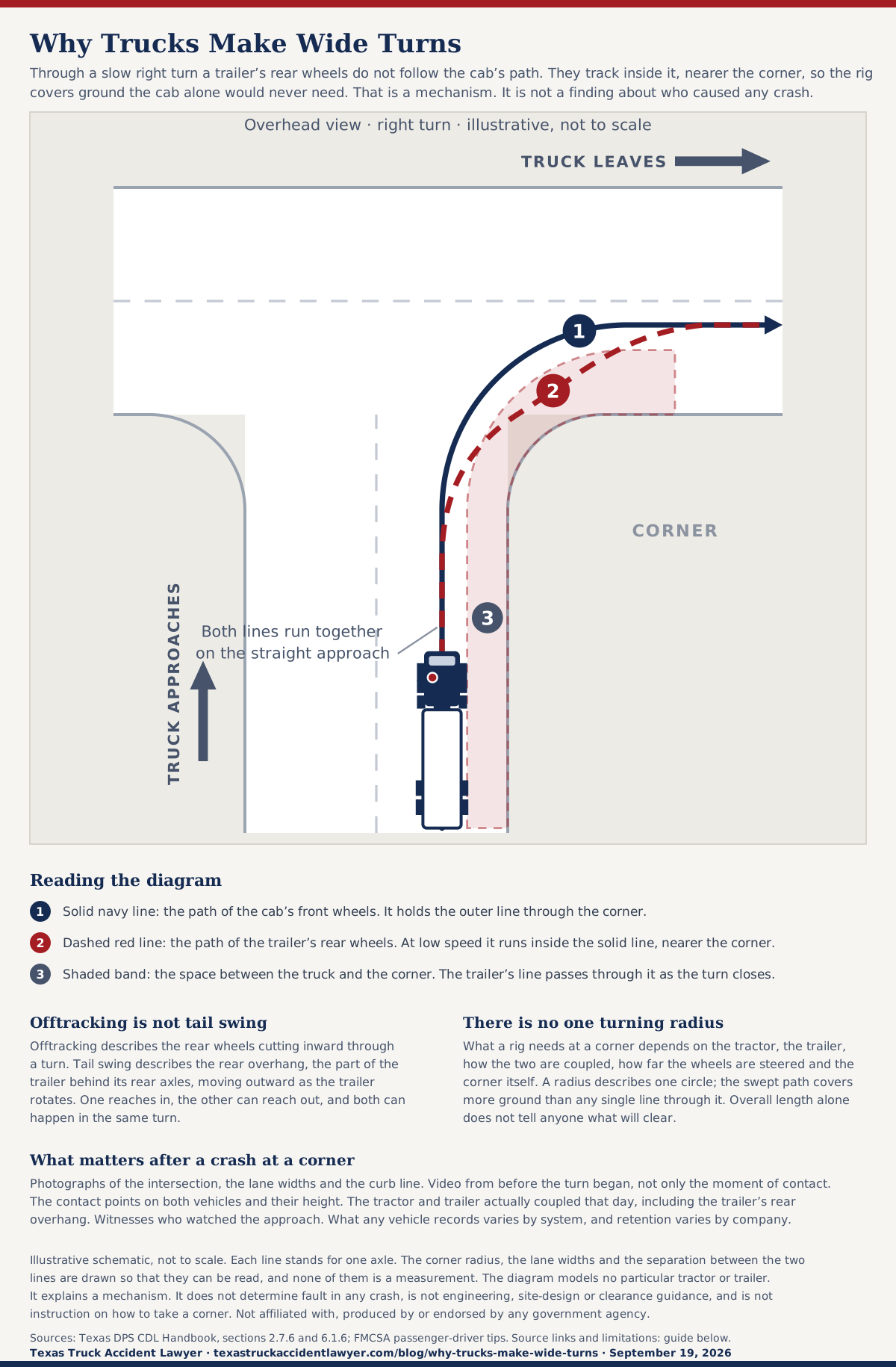
Two lines through one right turn
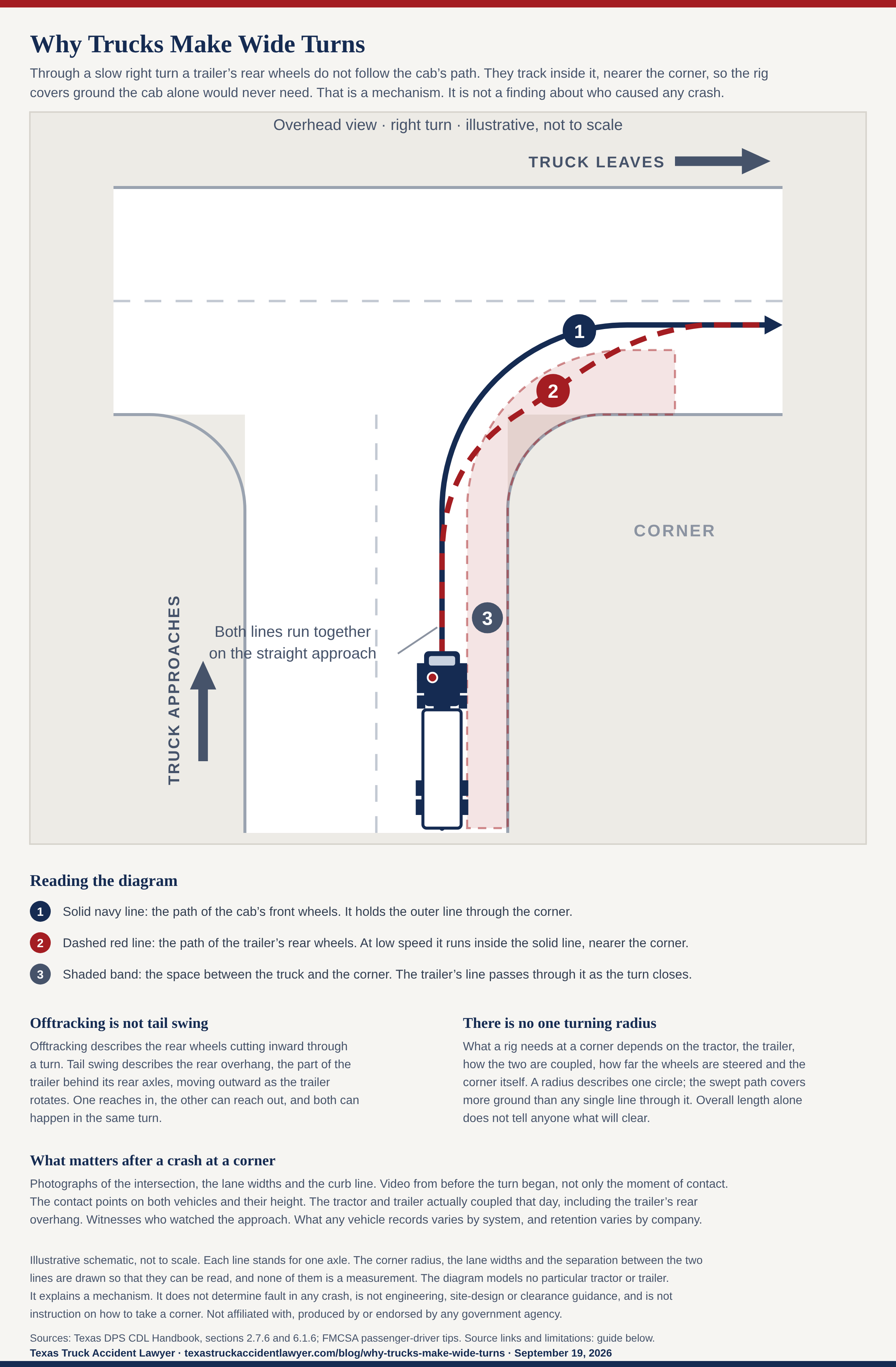
An overhead schematic of a tractor-trailer turning right at a corner. The rig travels up the page and leaves to the right. One line follows the cab's front wheels. A second line follows the trailer's rear wheels.
- Solid line. The cab's front wheels.
- Dashed line. The trailer's rear wheels.
- Shaded band. The space between the truck and the corner.
Highlight one line in the diagram
All three explanations stay visible below the diagram.
The cab and its front wheels hold the outer line
What the drawing shows. On the straight approach the front wheels and the trailer's rear wheels run along the same wheel line. The solid line only leaves that shared line once the wheel is turned, and it holds the outer position all the way through the corner before settling into the cross street.
What it leaves open. How far out it goes depends on the corner, the speed of the turn and the tractor and trailer actually coupled together. The drawing shows the shape of the movement, not a distance.
The trailer's rear wheels cut inside the cab's line
What the drawing shows. The dashed line leaves the shared wheel line earlier and comes back to it later, and everywhere in between it sits inside the solid line, nearer the corner. That inward cut is called offtracking. The rear wheels arrive at the corner after the cab has passed it, and on a tighter line than the cab took.
What it leaves open. Offtracking is not the same thing as tail swing. Offtracking describes the rear wheels cutting inward. Tail swing describes the rear overhang, the part of the trailer behind its rear axles, moving outward as the trailer rotates. One reaches in and the other can reach out, and both can happen in the same turn.
The space between the truck and the corner closes
What the drawing shows. The shaded band is the room between the truck and the corner. On the approach it can look like a lane of its own. The dashed line runs straight through it, which is the point: the space a trailer is about to occupy is open until the moment it is not.
What it leaves open. A useful habit follows from that, and it is road-safety advice rather than a legal rule. Do not squeeze between a turning truck and the curb, and let the turn finish. If a crash has already happened, that habit is not a finding that an injured person caused it.
A wide turn is a mechanism, not a verdict. The extra room a rig covers at a corner explains how two vehicles can end up in the same space. It does not tell anyone who was responsible for putting them there.
The Texas Commercial Motor Vehicle Drivers Handbook, section 6.1.6, explains this offtracking: the trailer's rear wheels take a different path from the tractor's front wheels. Our drawing illustrates that principle; it is not a measurement of a particular truck.
Semi-truck turning radius: there is no one number
People searching for a semi-truck turning radius usually want a single figure to settle an argument. There is not one. What a rig needs at a corner depends on the tractor's wheelbase, the trailer's length and where its axles sit, how the two are coupled, how far the wheels are steered, the speed of the turn and the corner itself. Two rigs of the same overall length can need different room.
Radius is also the wrong measure on its own. A radius describes one circle. What matters at a corner is the swept path, the whole strip of ground covered by every part of the vehicle, and that is wider than any single line through it. Rear overhang can reach outside the wheel tracks at the same moment the wheels are cutting inside them. Our page on semi truck dimensions and weight sets out the size limits that do exist, and none of them yields a turning figure for a particular rig.
None of this is engineering guidance. We are not offering a site-design or clearance calculation, a reconstruction of anyone's crash, or instruction on how to take a corner. We are describing a mechanism so that a collision at a corner makes sense to the person it happened to.
What the guidance says, and what Texas law asks
The Federal Motor Carrier Safety Administration tells motorists, in its tips for passenger vehicle drivers, that trucks and buses need extra space and extra time to turn, and that a truck or bus making a right turn may first move left. That is public safety guidance written for the motoring public. It is not a mandate, not a blanket entitlement to a second lane, and not a rule that makes any particular left-then-right movement safe or legal.
Texas traffic law speaks to the movement itself. Transportation Code § 545.101(a) requires an operator making a right turn at an intersection to make both the approach and the turn as closely as practicable to the right-hand curb or edge of the roadway. Section 545.060 requires a vehicle on a roadway divided into lanes to be driven as nearly as practical entirely within a single lane, and not moved from that lane unless the movement can be made safely. Section 545.103 says an operator may not turn a vehicle, or move right or left on a roadway, unless the movement can be made safely. Section 545.104 requires a signal of the intention to turn or change lanes, and a continuous signal for at least the last 100 feet of movement before a turn.
The Texas CDL handbook, sections 2.7.6 and 6.1.6, warns against swinging wide to the left before starting a right turn: a following motorist may mistake it for a left turn and try to pass on the right. FMCSA's description of what motorists may see is not an endorsement of that maneuver.
Read together these are duties, not permissions. A wide turn is not automatically unlawful, and a signal or a lane position does not by itself hand a truck the right of way. Official traffic-control devices may require a different turning course under Section 545.101(e). Whether a particular turn met these duties depends on the roadway, the traffic around it and what the operator actually did.
Three turns we are asked about
These are illustrations, not cases we have handled and not findings about anyone. Each separates what the geometry suggests from what we would have to see.
A vehicle alongside the inside of a right turn
What the geometry suggests. If the trailer's rear wheels run inside the cab's line, the space between the truck and the corner narrows while the turn is being made. A vehicle sitting in that space can be reached by the trailer before the trailer's wheels ever get to the corner.
What we would need. Which vehicle was there first, and for how long. Whether that space was a marked lane, a shoulder or a bicycle lane. Signal use and its timing. Photographs of the intersection and the curb line. The contact points on both vehicles and their height. Video from before the turn started, not only from the moment of contact.
A truck moves left, then turns right
What the geometry suggests. A rig can end up positioned left of the curb line before a right turn. That position on its own settles nothing. It is consistent with an operator making room for the trailer, and it is equally consistent with an operator who opened a space, never checked it and then closed it.
What we would need. The lane and roadway width at that corner. Whether the leftward movement crossed a lane line, and whether it could be made safely. Signals and their timing. The tractor and trailer actually coupled that day. Whether the other vehicle was overtaking or was already alongside when the movement began.
Tail swing into the space alongside
What the geometry suggests. Rear overhang, the part of the trailer behind its rear axles, can move outward as the trailer rotates, in the opposite direction to the wheels cutting in. Damage can appear on a stopped vehicle or a fixed object that sat outside the truck's wheel tracks.
What we would need. The height and direction of the scrape, and any paint transfer. The trailer's rear overhang as built. The final positions of both vehicles. Accounts from people who watched the trailer rotate.
None of the three tells us that a truck operator caused the crash, and none tells us that the operator of a passenger vehicle did.
How Texas divides responsibility when both sides are blamed
Where Chapter 33 of the Texas Civil Practice and Remedies Code applies, an injured person's own share of responsibility is measured as a percentage. Section 33.001 bars recovery if that percentage is greater than 50 percent. If it is 50 percent or less, Section 33.012 directs that damages be reduced in proportion to the percentage assigned.
Positions and signals do not settle those percentages on their own, and an insurer's allegation is not a finding. Whether the chapter applies and what percentages belong to whom depend on the facts and the claims involved. Our guide to being partly at fault in a Texas truck accident explains the threshold and the reduction, and our guide to truck blind spots covers the related argument that a driver could not see you.
The evidence we ask for after a turning crash
- The corner itself. Photographs of the intersection, the lane widths, the curb line and the markings, taken while conditions still match the crash and only from somewhere it is safe to stand.
- The seconds before the turn. Video from the tractor where a camera was fitted, from nearby businesses and from other motorists. How the turn began matters as much as how it ended.
- The contact points. Where each vehicle was struck, at what height, in which direction the scrapes run, and what paint transferred.
- The rig as it was that day. The tractor and trailer actually coupled together, the trailer's length, its axle positions and its rear overhang. Swap the trailer and the corner behaves differently.
- Witnesses, records and system data where they exist. People who watched the approach rather than only the impact. Some engine control modules and telematics systems record speed and braking around an event, and what gets recorded varies by vehicle, engine and system. There is no universal field holding steering input or signal use, and not every turn leaves a record. Our guide to truck black box data covers what these systems hold.
Retention varies by carrier, device and system, and no single retention window applies to every trucking company. We cannot promise that any particular record survives to any particular day, which is why a written preservation request should go out as early as possible; our guide to spoliation letters explains what one demands. Responsibility can also reach past the person behind the wheel to the carrier, broker or shipper.
Get the diagram
The turning-path diagram is free to download, with no form to fill in. It is an illustrative schematic, not to scale, and it models no particular vehicle.
- Wide-turn path diagram (SVG) — scales to any size without blurring.
- Wide-turn path diagram (PNG) — for slide decks and documents.
Suggested citation
Texas Truck Accident Lawyer, “Why Trucks Make Wide Turns,” https://texastruckaccidentlawyer.com/blog/why-trucks-make-wide-turns, September 19, 2026.
Select and copy the text above if the button is unavailable. Use this citation when referring readers to the guide. For publication permissions, contact us.
Questions we get asked
The documents behind these answers are listed under Sources at the end of this guide.
Why do trucks swing left before turning right?
Because a trailer's rear wheels track inside the cab's line through a corner, a rig covers ground the cab alone would not need. The FMCSA tips for passenger vehicle drivers note that a truck or bus making a right turn may first move left. That describes what can happen. It is not a mandate, not an entitlement to a second lane, and not a rule that makes a particular movement safe or legal. Texas law still requires the movement to be made safely.
What is a semi-truck turning radius?
There is no single figure. What a rig needs at a corner depends on the tractor's wheelbase, the trailer's length and axle positions, how the two are coupled, how far the wheels are steered and the corner itself. A radius describes one circle, while the swept path covers more ground than any single line through it, so overall length alone cannot tell anyone what will clear.
Is a wide right turn illegal in Texas?
Not automatically. Transportation Code Section 545.101(a) requires the approach and the right turn to be made as closely as practicable to the right-hand curb or edge of the roadway. Sections 545.060 and 545.103 require lane movements and turns to be made safely, and Section 545.104 requires a continuous turn signal for at least the last 100 feet before a turn. Whether a particular turn met those duties depends on the roadway, the traffic and what the operator did.
A turning truck hit my car while I was beside it. Is that my fault?
Not by itself. Where your vehicle was is part of the analysis and does not settle it. Where Chapter 33 of the Texas Civil Practice and Remedies Code applies, recovery is barred if your share of responsibility is greater than 50 percent, and otherwise damages are reduced in proportion to the percentage assigned. We look at both vehicles' movements and at the available evidence before assessing responsibility.
Hurt at a corner where a truck was turning?
If a trailer came across the space your vehicle was in, the useful next step is finding out what records exist before they are gone. Call (832) 250-4888 or request a free case review. Tell us where your vehicle sat in relation to the truck and the corner, and we will tell you what we would go looking for.
Sources
- Texas DPS, Commercial Motor Vehicle Drivers Handbook, sections 2.7.6 and 6.1.6
- FMCSA, Tips for Driving Safely Around Large Trucks or Buses
- Texas Transportation Code § 545.101, Turning at Intersection
- Texas Transportation Code § 545.060, Driving on Roadway Laned for Traffic
- Texas Transportation Code § 545.103, Safely Turning
- Texas Transportation Code § 545.104, Signaling Turns; Use of Turn Signals
- Texas Civil Practice and Remedies Code § 33.001, Proportionate Responsibility
- Texas Civil Practice and Remedies Code § 33.012, Amount of Recovery
This article provides general information, not legal advice about your situation. Reading it does not create an attorney-client relationship.

No fee unless we win.
Past results do not guarantee a similar outcome.